Today's
EarthStation1.com 15% Off Commemorative Memorial Title: The Old
Time Radio Crime & Detective MP3 MegaSet DVD, Download, USB
Today, May 26, 2026
May 26: National Blueberry Cheesecake
Day: -- A day dedicated to the blueberry cheesecake, one of the
most popular desserts in the U.S. Although originating in ancient
Greece, cheesecakes have today spread to the far corners of the
world and each region has its own varieties of cheesecakes. One
such very popular variety is the blueberry cheesecake. Cheesecake
is a rich dessert cake made with cream and soft cheese on a graham
cracker, cookie, or pastry crust. Often, it is topped with a fruit
compote or puree. Every year on May 26, people all around the U.S.
celebrate National Blueberry Cheesecake Day. Legend has it that
blueberry cheesecakes were fed to the athletes at the Olympic
Games in Greece. It is a historical dessert that has been carried
on through centuries without losing popularity. While cheesecakes
can be traced back to ancient Greece, the cheesecakes that people
eat now are a more recent innovation. People have come up with
different kinds of interesting flavors for cheesecakes but May 26
is the celebration of the classic blueberry cheesecake. As
cheesecakes spread to different countries, more ingredients were
added and different varieties began popping up. While in America,
cream cheese is the primary ingredient for cheesecakes, Italians
prefer to use ricotta. On the other hand, Germany and Poland use
quark, a special kind of curd cheese. As cheesecakes became
localized with time, bakers thought of newer innovations for it.
One of the most popular innovations was the addition of fruit to
cheesecakes and perhaps the best of them all was the sweet and
enticing blueberries! Blueberry cheesecakes, too, come in a number
of varieties. Some of the most unique blueberry cheesecakes
include blueberry mint cheesecakes, chocolate blueberry
cheesecakes, and kombucha blueberry cheesecakes! On Sale @ 15% Off
Discount Till Midnight PT!
https://store.earthstation1.com/old-time-radio-crime-and-detective-megaset-3-dual-layer-mp3-dv33.html
Today's
EarthStation1.com 15% Off Commemorative Memorial Title: Those
Oldies But Goodies Rock & Roll Doo-Wop MP3 Set DVD Download
USB
Today, May 26, 2026
May 26: National Cherry Dessert Day: -- A
sweet tooth's holiday that celebrates cherries, the fruit that
seem to go perfectly well with almost anything! From cherry
cobblers to cherry cheesecakes, the versatility of this simple
fruit is endless. That trait, and of course its amazing taste, and
health benefits are the things we celebrate on National Cherry
Day. Cherries can be wild or tame, from bush or tree, and give us
more vitamins and minerals than we can count. Today is
specifically set aside every year to pay homage to cherry
desserts, leaving us with insatiable cravings and inspiring ideas.
There are different types and even colors of cherries that have
been identified throughout history. Some of them include true
cherries, bird cherries or cherry laurels, and bush cherries, with
the term 'wild cherries' referring to cherries growing outside
cultivation. The word cherry was coined from the Old Nothern
French word 'cherise,' which was derived from the Latin word
'cerasum' to refer to the ancient Greek region of Kerasous, which
is said to be the first place in Europe cherries were exported to.
In the US, cherries arrived first in Brooklyn, New York. Colonists
in Massachusetts planted the first sour cherry, which is still a
people's favorite. Queen Elizabeth I is given credit for making
the first cherry pie in the 1500s with the start of fruit pies and
tarts. Since then, a variety of cherry-flavored desserts have made
their way into the scene. Cherry can be used as a filling like in
cherry pie and cobbler, as part of the flavoring like cherry
cheesecake, or even as a topping like cherry tarts or biscuits.
The origins of National Cherry Dessert Day are still widely
unknown, but that does not stop us from celebrating this sweet
holiday! It is observed annually on May 26, after National Cherry
Month, and before Cherry Day. On Sale @ 15% Off Discount Till
Midnight PT!
https://store.earthstation1.com/those-oldies-but-goodies-rock-amp-roll-doo-wop-mp3-dv3.html
Today's
EarthStation1.com 15% Off Commemorative Memorial Title:
Hellzapoppin' 1941 Olsen & Johnson DVD, MP4 Video Download,
USB Stick
Today, May 26, 2026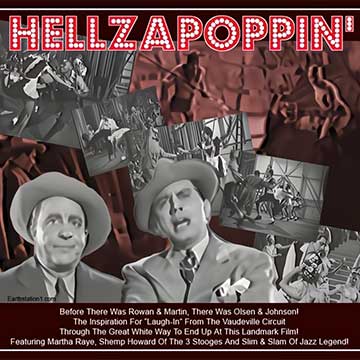
May 26: World Lindy Hop Day: -- Today
we're getting our dance shoes ready to hit the floor! There isn't
a better way to create some positive vibes than by dancing,
especially if you're doing it in the right environment with the
perfect music. That is what Lindy Hop is all about. A dancing
style that has endured time by bringing people together and
helping spread joy. The is an American dance style that made its
first appearance in the late 1920s with the popularisation of big
bands. It crosses over dance style traditions from Europe like
turns and embracing holds with body postures from Africa. Its
geographical origin can also be traced back to Harlem, New York
City. The Lindy is a fusion of many dances that preceded it, or
were popular during its development, but is mainly based on jazz,
tap, breakaway, and Charleston. It is frequently described as a
jazz dance and is a member of the swing dance family. It s often
synonymous with the jitterbug dance, but the jitterbug might
include elements of the jive, east coast swing, collegiate shag,
charleston, balboa and other swing dances. The name Lindy refers
to its often aerobatic elements, and comes from a trend that
occurred after Charles Lindbergh's successful flight across the
Atlantic in 1927. Many chefs, musicians, and even business owners
paid tribute to the aviator by naming the creations and their
establishments after this brave American. The dance evolved
together with the music it's danced to. The Lindy Hop reached
mainstream popularity during the 1930s with dance groups like the
Harlem Congaroos and Hot Chocolate performing at exhibitions. The
movie "Hellzapoppin'" also featured Lindy Hop dancers.
Lindy Hop enjoyed a revival since the mid 1980s, when Swing Legend
Frankie "musclehead" Manning, an influential
choreographer and performer of the era, was popularized it. World
Lindy Hop Day was established to honor his contributions. Today,
Lindy Hop communities can be found in many cities around the
world. One of the most famous examples is the town of Herrang in
Sweden, home of the Herrang Dance Camp, a famous meet up for Lindy
Hop enthusiasts. On Sale @ 15% Off Discount Till Midnight PT!
https://store.earthstation1.com/hellzapoppin39-dvd-olsen-and-johnson-vaudeville-lindyhoppi39.html
Today's
EarthStation1.com 15% Off Commemorative Memorial Title: The
Subterraneans 1960 Leslie Caron George Peppard DVD, Download, USB
Today, May 26, 2026
May 26: World Redhead Day: -- A day set
aside to celebrate everyone who has natural red hair. If you have
red hair, you are considered a part of a unique group because less
than 2% of the world's population is born with naturally red hair.
Red hair is more common and appears with greater frequency
(between 2% and 6%) among those of Northern European descent. Red
hair gets its color from high levels of the reddish pigment
pheomelanin and low levels of the dark pigment eumelanin. Redheads
are those whose hair has a variety of red hues - from a deep
burgundy or bright copper, or auburn, to burnt orange or
red-orange to strawberry blond. Red hair is usually associated
with fair skin color, lighter eye color, freckles, and sensitivity
to ultraviolet light. In ancient Asian civilizations (dating back
to the second millennium B.C.), people were said to have red and
auburn hair. There are several accounts of redheads in Greek
literature. The ancient people Budini, Sarmatians, and Thracians
were reported by Greek authors to be blue-eyed and red-haired.
Throughout history, red hair is believed to be good for women, but
not for men. Red hair has been associated with evil, vampires, and
witches; outsiders were usually portrayed sporting red hair
because red hair was not very common. Some historians also
attribute this negativity towards red hair to the belief that
Judas Iscariot (the disciple who betrayed Jesus) had red hair. Red
hair is also associated with someone with a temper. In the 16th
and 17th centuries, women who had red hair were stigmatized as
witches. An estimated 45,000 red-haired women suspected of being
witches were burned during the witch trials. Although there have
been instances of discrimination and indifference towards
redheads, acceptance, and celebration have become the norm.
Redhead festivals take place across the globe from the Netherlands
to Israel. There is also a magazine called "MC1R"
exclusively for redheads. ("MC1R" stands for
"melanocortin-1 receptor," a protein-coding gene.) On
Sale @ 15% Off Discount Till Midnight PT!
https://store.earthstation1.com/the-subterraneans-dvd-1960-leslie-caron-george-pep1960.html
Today's
EarthStation1.com 15% Off Commemorative Memorial Title: In Search
Of Dracula 1975 Christopher Lee DVD, MP4 Download, USB Drive
Today, May 26, 2026
May 26: World Dracula Day: -- May 26,
1897: First Publications: Bram Stoker's famous novel Dracula is
first published, one of the most famous pieces of English
literature, many of whose characters have entered popular culture
as archetypal versions of their characters, such as Count Dracula
as the quintessential vampire, and Abraham Van Helsing as an
iconic vampire hunter. World Dracula Day is celebrated every year
on May 26 in commemoration of its first publication. It is an
epistolary novel (a novel written as a series of letters), with
the narrative related through letters, diary entries, and
newspaper articles. It has no single protagonist, but opens with
solicitor Jonathan Harker taking a business trip to stay at the
castle of a Transylvanian nobleman, Count Dracula. Harker escapes
the castle after discovering that Dracula is a vampire, and the
Count moves to England and plagues the seaside town of Whitby. A
small group, led by Abraham Van Helsing, hunt Dracula and, in the
end, kill him. Dracula was mostly written in the 1890s. Stoker
produced over a hundred pages of notes for the novel, drawing
extensively from Transylvanian folklore and history. Some scholars
have suggested that the character of Dracula was inspired by
historical figures like the Wallachian prince Vlad the Impaler or
the countess Elizabeth Bathory, but there is widespread
disagreement. Stoker's notes mention neither figure. He found the
name Dracula in Whitby's public library while holidaying there,
picking it because he thought it meant devil in Romanian.
Following its publication, Dracula was positively received by
reviewers who pointed to its effective use of horror. In contrast,
reviewers who wrote negatively of the novel regarded it as
excessively frightening. Comparisons to other works of Gothic
fiction were common, including its structural similarity to Wilkie
Collins' The Woman in White (1859). In the past century, Dracula
has been situated as a piece of Gothic fiction. Modern scholars
explore the novel within its historical context-the Victorian
era-and discuss its depiction of gender roles, sexuality, and
race. The novel, which is in the public domain, has been adapted
for film over 30 times, and its characters have made numerous
appearances in virtually all media. On Sale @ 15% Off Discount
Till Midnight PT!
https://store.earthstation1.com/in-search-of-dracula-1975-documentary-starring-christopher1975.html
Today's
EarthStation1.com 15% Off Commemorative Memorial Title: We
Remember: The Space Shuttle Pioneers 1981-1986 DVD, Download, USB
Today, May 26, 2026
May 26: Sally Ride Day: -- May 26, 1951:
#BOTD: #HBD! Sally Ride, American pilot, PhD, astronaut, physicist
and beauty, youngest American astronaut to have flown in space,
first American woman and the third woman to fly in space, the only
known LGBT person, Astronaut or Cosmonaut, to travel in space at
age 32 (d. July 23, 2012) is #born Sally Kristen Ride in the
Encino neighborhood of Los Angeles, California. Sally Ride Day is
a special appreciation holiday that is held on May 26 every year
in commemoration of her birthday. Ride was a graduate of Stanford
University, where she earned a Bachelor of Science degree in
physics and a Bachelor of Arts degree in English literature in
1973, a Master of Science degree in physics in 1975, and a Doctor
of Philosophy in physics in 1978 for research on the interaction
of X-rays with the interstellar medium. She was selected as a
mission specialist astronaut with NASA Astronaut Group 8, the
first class of NASA astronauts to include women. After completing
her training in 1979, she served as the ground-based capsule
communicator (CapCom) for the second and third Space Shuttle
flights, and helped develop the Space Shuttle's robotic arm. In
June 1983, she flew in space on the Space Shuttle Challenger on
the STS-7 mission. The mission deployed two communications
satellites and the first Shuttle pallet satellite (SPAS-1). Ride
operated the robotic arm to deploy and retrieve SPAS-1. Her second
space flight was the STS-41-G mission in 1984, also on board
Challenger. She spent a total of more than 343 hours in space. She
left NASA in 1987. Ride worked for two years at Stanford
University's Center for International Security and Arms Control,
then at the University of California, San Diego, primarily
researching nonlinear optics and Thomson scattering. She served on
the committees that investigated the loss of Challenger and of
Columbia, the only person to participate in both. Having been
married to astronaut Steven Hawley during her spaceflight years
and in a private, long-term relationship with former Women's
Tennis Association player Tam O'Shaughnessy, she is the first
astronaut known to have been LGBT. She died of pancreatic cancer
at her home in La Jolla, California at the age of 61. Following
cremation, her ashes were interred next to those of her father at
Woodlawn Memorial Cemetery, Santa Monica. Her papers are in the
National Air and Space Museum Archives of the Smithsonian
Institution. Ride's obituary publicly revealed for the first time
that O'Shaughnessy had been her partner of 27 years. This made
Ride the first known LGBT astronaut. The relationship was
confirmed by Ride's sister Bear, who said Ride chose to keep her
personal life private, including her sickness and treatments. On
Sale @ 15% Off Discount Till Midnight PT!
https://store.earthstation1.com/we-remember-the-space-shuttle-pioneers-198119811986.html
Today's
EarthStation1.com 15% Off Commemorative Memorial Title: Native
North American Indian History Documentaries MP4 Downloads DVDs
Today, May 26, 2026
May 26, 1830: The United States: The
History Of The United States: Native Americans: The History Of
Native Americans: Forced Migrations Of Native Americans In The
United States: The Indian Removal Act: -- The United States
Congress passes The Indian Removal Act, which is signed into law
by President Andrew Jackson two days later. The law authorized the
president to negotiate with southern Native American tribes for
their removal to federal territory west of the Mississippi River
in exchange for their lands. The act has been referred to as a
genocide. The Act was signed by Jackson and it was enforced under
his administration and that of Martin Van Buren. The act enjoyed
strong support from the non-Indian peoples of the South, but there
was a large amount of resistance from the Indian tribes, the Whig
Party, and whites in the northeast, especially New England. The
Cherokee worked together as an independent nation to stop this
relocation. However, the Cherokee were unsuccessful in their
attempt to keep their land and were eventually forcibly removed by
the United States government in a march to the west that later
became known as the Trail of Tears, a series of forced relocations
of Native American peoples that included members of the Cherokee,
Muscogee (Creek), Seminole, Chickasaw, Choctaw, and Ponca nations.
On Sale @ 15% Off Discount Till Midnight PT!
https://store.earthstation1.com/native-north-american-indian-history-documentaries-dvd-mp4-us4.html
Today's
EarthStation1.com 15% Off Commemorative Memorial Title: The
American Adventure: TV History Series 1607-1876 DVD MP4 USB Drive
Today, May 26, 2026
May 26, 1857: Origins Of The American
Civil War (The Civil War, The War Between The States): Events
Leading To The American Civil War: Slavery: Slavery In The United
States: Landmark Court Decisions In The United States: Landmark
Supreme Court Of The United States (SCOTUS) Decisions: Dred Scott
v. Sandford: The Manumission Of Dred Scott: -- Dred Scott (c. 1799
- September 17, 1858), enslaved African American man in the United
States who unsuccessfully sued for his freedom and that of his
wife and their two daughters in the Dred Scott v. Sandford case of
1857, popularly known as the "Dred Scott Case", is
manumitted (emancipated) by the Blow family, his original owners.
Scott's freedom suit before the state courts was backed
financially by the children of Peter Blow, the original owner of
Dred Scott, as his children had turned against slavery in the
decade since they sold Scott. Henry Taylor Blow became a
Republican Congressman after the Civil War, Charlotte Taylor Blow
married the son of an abolitionist newspaper editor, and Martha
Ella Blow married Charles D. Drake, one of Scott's lawyers who
became a Republican Senator. Members of the Blow family signed as
security for Scott's legal fees and secured the services of local
lawyers. While the case was pending, Scott was leased out by the
St. Louis County sheriff, who held the payments in escrow. In
1851, Scott was leased by Charles Edmund LaBeaume, whose sister
had married into the Blow family. Scott worked as a janitor at
LaBeaume's law office, which was shared with Roswell Field. Scott
claimed that he and his wife should be granted their freedom
because they had lived in Illinois and the Wisconsin Territory for
four years, where slavery was illegal. The United States Supreme
Court decided 7-2 against Scott, finding that neither he nor any
other person of African ancestry could claim citizenship in the
United States, and therefore Scott could not bring suit in federal
court under diversity of citizenship rules. Moreover, Scott's
temporary residence outside Missouri did not bring about his
emancipation under the Missouri Compromise, which the court ruled
unconstitutional as it would "improperly deprive Scott's
owner of his legal property". While Chief Justice Roger B.
Taney had hoped to settle issues related to slavery and
Congressional authority by this decision, it aroused public
outrage, deepened sectional tensions between the northern and
southern U.S. states, and hastened the eventual explosion of their
differences into the American Civil War. President Abraham
Lincoln's Emancipation Proclamation in 1863, and the post-Civil
War Reconstruction Amendments - the Thirteenth, Fourteenth and
Fifteenth amendments - nullified the decision. On Sale @ 15% Off
Discount Till Midnight PT!
https://store.earthstation1.com/the-american-adventure-series-us-1st-century-4-dv14.html
Today's
EarthStation1.com 15% Off Commemorative Memorial Title: Long
Shadows: Civil War Legacy DVD, Video Download, USB Flash Drive
Today, May 26, 2026
May 26, 1868: Federal Impeachments In The
United States: The Reconstruction Era (Reconstruction): The
Impeachment Of Andrew Johnson: -- United States President Andrew
Johnson impeachment trial ends with his acquittal by one vote
after a ten-day recess was called by the United States Senate
before they attempted to convict him on additional articles from
the ones that they failed to impeach him on when they voted on a
different article of impeachment on May 16. The Impeachment of
Andrew Johnson occurred in 1868, when the United States House Of
Representatives resolved to impeach President Andrew Johnson,
adopting eleven articles of impeachment detailing his "high
crimes and misdemeanors," in accordance with Article Two of
the United States Constitution. The House's primary charge against
Johnson was violation of the Tenure of Office Act, passed by the
U.S. Congress in March 1867, over the president's veto.
Specifically, he had removed from office Edwin M. Stanton, the
Secretary of War - whom the Act was largely designed to protect -
and attempted to replace him with Brevet Major General Lorenzo
Thomas (Earlier, while Congress was not in session, Johnson had
suspended Stanton and appointed General Ulysses S. Grant as
secretary of war ad interim). The House approved the articles of
impeachment on March 2-3, 1868, and forwarded them to the Senate.
The trial in the Senate began three days later, with Chief Justice
of the United States Salmon P. Chase presiding. On May 16, the
Senate failed to convict Johnson on one of the articles, with the
35-19 vote in favor of conviction falling short of the necessary
two-thirds majority by a single vote. A ten-day recess was called
before attempting to convict him on additional articles. The delay
did not change the outcome, however, as on May 26, it failed to
convict the President on two articles, both by the same margin;
after which the trial was adjourned. This was the first
impeachment of a President since creation of the office in 1789.
The culmination of a lengthy political battle between Johnson, a
lifelong Democrat and the Republican majority in Congress over how
best to deal with the defeated Southern states following the
conclusion of the American Civil War, the impeachment, and the
subsequent trial (and acquittal) of Johnson were among the most
dramatic events in the political life of the nation during the
Reconstruction Era. Together, they have gained a historical
reputation as an act of political expedience, rather than
necessity, which was based on Johnson's defiance of an
unconstitutional piece of legislation, and which was conducted
with little regard for the will of a general public which, despite
the unpopularity of Johnson, opposed the impeachment. Johnson is
one of only three presidents against whom articles of impeachment
have been reported to the full House for consideration. In 1974,
during the Watergate scandal, the House Judiciary Committee
approved articles of impeachment against Richard Nixon, who
resigned from office, rather than face certain impeachment and the
prospect of being convicted at trial and removed from office. In
1999, Bill Clinton was impeached; He, like Johnson, was acquitted
from all charges following a Senate trial. On Sale @ 15% Off
Discount Till Midnight PT!
https://store.earthstation1.com/long-shadows-dvd-legacy-of-the-american-civil-war.html
Today's
EarthStation1.com 15% Off Commemorative Memorial Title: Clive
James' Fame In The 20th Century TV Series DVD Set MP4 USB Drive
Today, May 26, 2026
May 26 (or 27), 1877: #BOTD: #HBD!
Isadora Duncan, American-Russian dancer and choreographer who
performed to great acclaim throughout Europe (d. September 14,
1927) is #born Angela Isadora Duncan in San Francisco and raised
in California. She lived and danced in Western Europe and the
Soviet Union from the age of 22 until her death at age 50 when her
scarf became entangled in the wheels and axle of the car in which
she was travelling in Nice, France. She is buried at The Cimetiere
Du Pere Lachaise in Paris, France. On Sale @ 15% Off Discount Till
Midnight PT!
https://store.earthstation1.com/clive-james39-fame-in-the-20th-century-tv-series-dvd-set-mp4-usb-39204.html
Today's
EarthStation1.com 15% Off Commemorative Memorial Title: Hollywood
(1980) Silent Movie History Series DVD, Video Download, USB
Today, May 26, 2026
May 26, 1886: #BOTD: #HBD! Al Jolson,
American singer, comedian, and stage and film actor (d. October
23, 1950) is #born Asa Yoelson in the Jewish village of Srednike,
now known as Seredzius, near Kaunas in Lithuania, then part of the
Russian Empire. One of the premier American vaudeville
entertainers of his day, he appeared in the first motion picture
with full sound, The Jazz Singer, in 1927. At the peak of his
career, he was dubbed "The World's Greatest Entertainer."
His performing style was brash and extroverted, and he popularized
a large number of songs. Numerous well-known singers were
influenced by his music, including Bing Crosby, George Burns, Bob
Dylan, Rod Stewart, David Bowie and others. Dylan once referred to
him as "somebody whose life I can feel.". In the 1920s,
Jolson was America's most famous and highest-paid entertainer.
Between 1911 and 1928, Jolson had nine sell-out Winter Garden
shows in a row, more than 80 hit records, and 16 national and
international tours. Although best remembered today as the star of
the first talking picture, The Jazz Singer (1927), he later
starred in a series of successful musical films throughout the
1930s. After the attack on Pearl Harbor, he was the first star to
entertain troops overseas during World War II. After a period of
inactivity, his stardom returned with The Jolson Story (1946), for
which Larry Parks played Jolson, with the singer dubbing for
Parks. The formula was repeated in a sequel, Jolson Sings Again
(1949). In 1950, he again became the first star to entertain GIs
on active service in the Korean War, performing 42 shows in 16
days. Al Jolson died of a massive heart attack while playing cards
in his suite at the St. Francis Hotel at 335 Powell Street in San
Francisco, California, aged 64, just weeks after returning to the
U.S. from becaming the first star to entertain GIs on active
service in the Korean War, a death partly owing to the physical
exertion of performing 42 shows in 16 days. His last words were
said to be "Oh ... oh, I'm going." After his wife
received the news of his death by phone, she went into shock, and
required family members to stay with her. At the funeral, police
estimated that upwards of 20,000 people showed up, despite the
threat of rain. It became one of the biggest funerals in show
business history. Celebrities paid tribute: Bob Hope, speaking
from Korea via shortwave radio, said the world had lost "not
only a great entertainer, but also a great citizen". Larry
Parks said that the world had "lost not only its greatest
entertainer, but a great American as well. He was a casualty of
the [Korean] war." He is buried in Hillside Memorial Park
cemetery in Culver City, Los Angeles County, California. Defense
Secretary George Marshall posthumously awarded him The Medal Of
Merit. According to the St. James Encyclopedia of Popular Culture,
"Jolson was to jazz, blues, and ragtime what Elvis Presley
was to rock 'n' roll." Being the first popular singer to make
a spectacular event out of singing a song, he became a rock star
before the dawn of rock music. His specialty was performing on
stage runways extending out into the audience. He would run up and
down the runway, and across the stage, "teasing, cajoling,
and thrilling the audience", often stopping to sing to
individual members; all the while the "perspiration would be
pouring from his face, and the entire audience would get caught up
in the ecstasy of his performance". According to music
historian Larry Stempel, "No one had heard anything quite
like it before on Broadway." Author Stephen Banfield agreed,
writing that Jolson's style was "arguably the single most
important factor in defining the modern musical". Jolson has
been called "the king of blackface"., a theatrical
convention since the mid-19th century. With his unique and dynamic
style of singing black music, such as jazz and blues, he was
became widely successful by extracting African American music and
popularizing it for white American audiences who were otherwise
not receptive to the originators. Alongside his promotion and
perpetuation of anti-black stereotypes, his work was sometimes
well-regarded among black publications and he has sometimes been
credited for fighting against black discrimination on Broadway, as
early as 1911. In an essay written in the 21st century Tim Gioia
of the Jim Crow Museum of Racist Memorabilia remarks, "If
blackface has its shameful poster boy, it is Al Jolson",
showcasing Jolson's complex legacy in American society. On Sale @
15% Off Discount Till Midnight PT!
https://store.earthstation1.com/hollywood-1980-tv-documentary-series-13-shows-4-dual-lay1980134.html
Today's
EarthStation1.com 15% Off Commemorative Memorial Title: London:
The First Defiant City Cities At War Series DVD, Download, USB
Today, May 26, 2026
May 26, 1904: #BOTD: #HBD! George Formby,
English singer, songwriter, comedian and actor who became known to
a worldwide audience through his films of the 1930s and 1940s (d.
March 6, 1961) is #born George Hoy Booth at 3 Westminster Street,
Wigan, Lancashire. On stage, screen and record he sang light,
comical songs, usually playing the ukulele or banjolele, and
became the UK's highest-paid entertainer. George Formby, OBE was
the son of George Formby Sr, from whom he later took his stage
name. After an early career as a stable boy and jockey, Formby
took to the music hall stage after the early death of his father
in 1921. His early performances were taken exclusively from his
father's act, including the same songs, jokes and characters. In
1923 he made two career-changing decisions - he purchased a
ukulele, and married Beryl Ingham, a fellow performer who became
his manager and transformed his act. She insisted that he appear
on stage formally dressed, and introduced the ukulele to his
performance. He started his recording career in 1926 and, from
1934, he increasingly worked in film to develop into a major star
by the late 1930s and 1940s, and became the UK's most popular
entertainer during those decades. The media historian Brian
McFarlane writes that on film, Formby portrayed gormless (lacking
sense or initiative; foolish) Lancastrian innocents who would win
through against some form of villainy, gaining the affection of an
attractive middle-class girl in the process. During the Second
World War Formby worked extensively for the Entertainments
National Service Association (ENSA), and entertained civilians and
troops, and by 1946 it was estimated that he had performed in
front of three million service personnel. After the war his career
declined, although he toured the Commonwealth, and continued to
appear in variety and pantomime. His last television appearance
was in December 1960, two weeks before the death of Beryl. He
surprised people by announcing his engagement to a school teacher,
Pat Howson, seven weeks after Beryl's funeral, but Formby died in
Preston three weeks later, at the age of 56; he was buried in
Warrington, alongside his father. Formby's biographer, Jeffrey
Richards, considers that the actor "had been able to embody
simultaneously Lancashire, the working classes, the people, and
the nation". Formby was considered Britain's first properly
home-grown screen comedian. He was an influence on future
comedians-particularly Charlie Drake and Norman Wisdom-and,
culturally, on entertainers such as the Beatles, who referred to
him in their music (their penultimate song, "Free as a Bird",
ends with a slight coda including a strummed ukulele by Harrison
and the voice of John Lennon played backwards, saying "Turned
out nice again", the name of Formby's 1941 comedy film.).
Since his death Formby has been the subject of five biographies,
two television specials and two works of public sculpture. On Sale
@ 15% Off Discount Till Midnight PT!
https://store.earthstation1.com/london-the-first-defiant-city-dvd-cities-at-war-wwii-britainhtm.html
Today's
EarthStation1.com 15% Off Commemorative Memorial Title: Three
Musketeers 1933 John Wayne Lon Chaney Jr. Noah Beery DVD MP4 USB
Today, May 26, 2026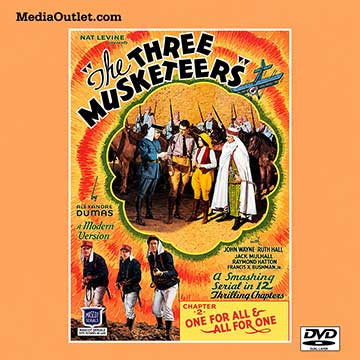
May 26, 1907: #BOTD: #HBD! John Wayne,
American actor, singer, director, filmmaker and producer,
nicknamed Duke or Duke Wayne, among the top box office draws for
three decades, Academy Award-winner for True Grit (1969) (d. June
11, 1979) is #born Marion Robert Morrison at 224 South Second
Street in Winterset, Iowa. The local paper, Winterset Madisonian,
reported on page 4 of the edition of May 30, 1907, that Wayne
weighed 13 lb at birth. Wayne claimed his middle name was soon
changed from Robert to Michael when his parents decided to name
their next son Robert, but extensive research has found no such
legal change, although it might have been changed informally or
the documention may have been lost. Wayne's legal name apparently
remained Marion Robert Morrison his entire life although to this
day his original name is almost always referred to as Marion
Michael Morrison. Wayne grew up in Southern California. He was
president of Glendale High class of 1925. He found work at local
film studios when he lost his football scholarship to the
University of Southern California as a result of a bodysurfing
accident. Initially working for the Fox Film Corporation, he
appeared mostly in small bit parts. His first leading role came in
Raoul Walsh's widescreen epic The Big Trail (1930), which led to
leading roles in numerous B movies throughout the 1930s, most of
them in the Western genre. Wayne's career took off in 1939, with
John Ford's Stagecoach making him an instant star. He went on to
star in 142 motion pictures altogether, including the dozens with
his name above the title produced before 1939. Wayne's other
well-known Western roles include a cattleman driving his herd
north on the Chisholm Trail in Red River (1948), a Civil War
veteran whose young niece is abducted by a tribe of Comanches in
The Searchers (1956), a troubled rancher competing with a lawyer
(James Stewart) for a woman's hand in marriage in The Man Who Shot
Liberty Valance (1962), and a cantankerous one-eyed marshal in
True Grit (1969). He is also remembered for his roles in The Quiet
Man (1952), Rio Bravo (1959) with Dean Martin, and The Longest Day
(1962). In his final screen performance, he starred as an aging
gunfighter battling cancer in The Shootist (1976). He appeared
with many important Hollywood stars of his era, and his last
public appearance was at the Academy Awards ceremony on April 9,
1979. John Wayne died of stomach cancer in Los Angeles,
California, aged 72. He is buried at Pacific View Memorial Park
cemetery at Corona del Mar, California. On Sale @ 15% Off Discount
Till Midnight PT!
https://store.earthstation1.com/three-musketeers-1933-dvd-12-part-movie-serial-john193312.html
Today's
EarthStation1.com 15% Off Commemorative Memorial Title: DJ
Madness! 1950s-60s-70s Radio Shows DVD, MP3 Download, USB Drive
Today, May 26, 2026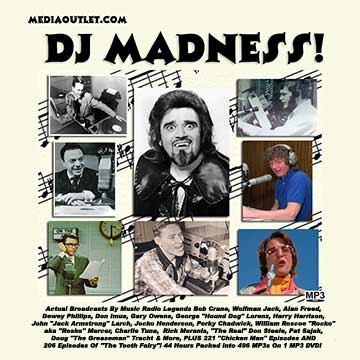
May 26, 1916: #BOTD: #HBD! Moondog,
American-German singer-songwriter, composer, musician, drummer,
inventor of several musical instruments, theoretician and poet (d.
September 8, 1999) is #born Louis Thomas Hardin in Marysville,
Kansas. He was widely recognized as "the Viking of 6th
Avenue" by thousands of passersby and residents who were not
aware of his musical career. On July 4, 1932, the 16-year-old
Hardin found an object in a field which he did not realise was a
dynamite cap. While he was handling it the explosive detonated in
his face and permanently blinded him. In 1943, Hardin moved to New
York, where he met noted classical music luminaries such as
Leonard Bernstein and Arturo Toscanini, as well as jazz
performer-composers such as Charlie Parker and Benny Goodman,
whose upbeat tempos and often humorous compositions would
influence Hardin's later work. Moondog won a 1954 case in the New
York State Supreme Court against disc jockey Alan Freed, who had
branded his radio show, "The Moondog Rock and Roll Matinee",
around the name "Moondog", using "Moondog's
Symphony" (the first record that Moondog ever cut) as his
"calling card". Moondog believed he would not have won
the case had it not been for the help of musicians such as Benny
Goodman and Arturo Toscanini, who testified that he was a serious
composer. Freed had to apologize and stop using the nickname
"Moondog" on air, on the basis that Hardin was known by
the name long before Freed began using it. Hardin lived in New
York City from the late 1940s until 1972, and during this time he
could often be found on 6th Avenue, between 52nd and 55th Streets,
wearing a cloak and a horned helmet sometimes busking or selling
music, but often just standing silently on the sidewalk. Moondog
also invented several musical instruments, including a small
triangular-shaped harp known as the "oo", another which
he named the "ooo-ya-tsu", and a triangular stringed
instrument played with a bow that he called the "hus"
(after the Norwegian, "hus", meaning "house").
Perhaps his best known creation is the "trimba", a
triangular percussion instrument that the composer invented in the
late 1940s. The original Trimba is still played today by Moondog's
friend Stefan Lakatos, a Swedish percussionist, to whom Moondog
also explained the methods for building such an instrument. Along
with his passion for Nordic culture, Moondog had an idealised view
of Germany ("The Holy Land with the Holy River" - the
Rhine), where he settled in 1974. Moondog revisited the United
States briefly in 1989, for a tribute at the New Music America
Festival in Brooklyn, in which festival director Yale Evelev asked
him to conduct the Brooklyn Philharmonic Chamber Orchestra,
stimulating a renewed interest in his music. Eventually, a young
German student named Ilona Goebel (later known as Ilona Sommer)
helped Moondog set up the primary holding company for his artistic
endeavorsand hosted him, first in Oer-Erkenschwick, and later on
in Munster in Westphalia. Moondog lived with Sommer's family and
they spent time together in Munster. During that period Moondog
created hundreds of compositions which were transferred from
Braille to sheet music by Sommer. Moondog spent the remainder of
his life in Germany. Moondog died in Munster, Germany from heart
failure, aged 83. He is buried at the Central Cemetery Munster.
His tomb was designed by the artist Ernst Fuchs after his death
mask. Moondog recorded many albums, and toured both in the U.S.
and in Europe-France, Germany and Sweden. Moondog's music from the
1940s and 1950s is said to have been a strong influence on many
early minimalist composers. Philip Glass has written that he and
Steve Reich took Moondog's work "very seriously and
understood and appreciated it much more than what we were exposed
to at Juilliard". In July 1956 the British jazz composer and
musician Kenny Graham recorded the album "Moondog and Suncat
Suites" with a thirteen-piece band featuring such notable
performers as Stan Tracey and Phil Seamen. "Moondog"
featured Graham's arrangements of ten Moondog compositions,
whereas "Suncat Suite" consisted of a sequence of six of
Graham's own compositions inspired by Moondog. HMV issued the
original vinyl album in 1957, and Trunk Records reissued it on CD
in 2010. Moondog inspired other musicians with several songs
dedicated to him. These include "Moondog" on Pentangle's
1968 album Sweet Child and "Spear for Moondog" (parts I
and II) by jazz organist Jimmy McGriff on his 1968 Electric Funk
album. Glam rock icon Marc Bolan and T. Rex made reference to him
in the song "Rabbit Fighter" with the line "Moondog's
just a prophet to the end_". The English pop group Prefab
Sprout included the song "Moondog" on their album
Jordan: The Comeback released in 1990. Big Brother and the Holding
Company featuring Janis Joplin covered his song "All Is
Loneliness" on their 1967 self-titled album. The song was
also covered by Antony and the Johnsons during their 2005 tour.
Mr. Scruff's single "Get a Move On" from his album Keep
It Unreal is structured around samples from "Bird's Lament".
New York band The Insect Trust play a cover of Moondog's song "Be
a Hobo" on their album Hoboken Saturday Night. The track
"Stamping Ground", with its odd preamble of Moondog
reciting one of his epigrams, was featured on the sampler double
album Fill Your Head with Rock (CBS, 1970). Canadian composer and
producer Daniel Lanois included a track called "Moondog"
on his album/video-documentary Here Is What Is. Between 1970 and
1980 a blind bearded mystic called "Moondog" appeared as
the title character in a four issue series of Underground comix
written and illustrated by George Metzger. Disc jockey Rex Doane
has used elements of MoondogsSymphony as his standard audio bed
and theme for his WFMU radio show Fool's Paradise. On Sale @ 15%
Off Discount Till Midnight PT!
https://store.earthstation1.com/dj-radio-airchecks-mp3-dvd-1950s60s70s-dis319506070.html
Today's
EarthStation1.com 15% Off Commemorative Memorial Title: The Nat
King Cole Show 1956-1957 TV Series MP4 Video Download DVD Set
Today, May 26, 2026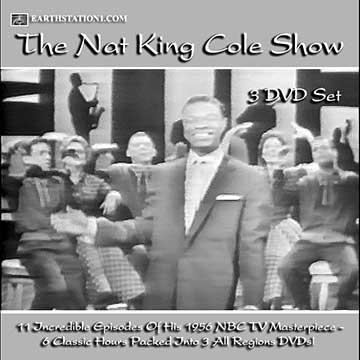
May 26, 1920: #BOTD: #HBD! Peggy Lee,
American jazz and popular music singer, songwriter, composer, and
actress, over a career spanning seven decades, called the Queen Of
American Pop Music (d. January 21, 2002) is #born Norma Deloris
Egstrom in Jamestown, North Dakota. From her beginnings as a
vocalist on local radio to singing with Benny Goodman's big band,
Lee created a sophisticated persona, writing music for films,
acting, and recording conceptual record albums combining poetry
and music. In 1942, Lee had her first number-one hit, "Somebody
Else Is Taking My Place", followed in 1943 by "Why Don't
You Do Right?", which sold more than one million copies and
made her famous. She sang with Goodman's orchestra in two 1943
films, Stage Door Canteen and The Powers Girl. Lee recorded over
1,100 masters and composed over 270 songs. Lee was nominated for
13 Grammy Awards. In 1969, her hit "Is That All There Is?"
won her the Grammy for Best Contemporary Vocal Performance.
Baseball's Tug McGraw, whose career with both the New York Mets
and Philadelphia Phillies ranged from 1965 to 1984, named one of
his pitches the Peggy Lee. He explained to The Philadelphia
Inquirer: "That's the one where the hitter is out in front of
it and says, 'Is that all there is?'" In 1995, she was given
the Grammy Lifetime Achievement Award. While Lee was in London for
a 1970 engagement at Royal Albert Hall, she invited Paul and Linda
McCartney to dinner at The Dorchester. At the dinner, the couple
gifted Lee with a song they had written entitled, "Let's
Love". In July 1974, with Paul McCartney producing, Lee
recorded the song at the Record Plant in Los Angeles, and it
became the title track for her 40th album, her only one on
Atlantic Records. In 1971, Lee sang the Lord's Prayer at the
funeral of Louis Armstrong. The designer of the Miss Piggy Muppet,
Bonnie Erickson, who grew up in Lee's home state of North Dakota,
used the singer as inspiration for the Miss Piggy character in
1974. Originally called Miss Piggy Lee, her name was shortened to
Miss Piggy when the Muppet gained fame. In 1975, Lee received an
honorary doctorate in music from North Dakota State University,
and in 2000, she received another from Jamestown University. In
1983, Lee had a hybrid tea rose named in her honor that was pink
with a touch of peach. The Peggy Lee Rose was the 1983 American
Beauty Rose of the Year. Lee has been noted as a musical influence
on other artists such as Paul McCartney, Madonna, Beyonce, k.d.
lang, Elvis Costello, Diana Krall, Dusty Springfield, Rita
Coolidge, Rita Moreno,[60] and Billie Eilish. Lee is often cited
as the inspiration for the Margarita cocktail. In 1948, after a
trip to Mexico, she and her husband ventured into the Balinese
Room in Galveston, Texas. She requested a drink similar to one she
had in Mexico, and the head bartender, Santos Cruz, created the
Margarita, and named it after the Spanish version of Peggy's name.
Peggy Lee died after years of poor health of complications from
diabetes and a heart attack at the age of 81 in Los Angeles,
California; Lee had continued to perform into the 1990s despite
her poor health, sometimes using a wheelchair. She was cremated
and her ashes were buried with a bench-style monument in Westwood
Village Memorial Park Cemetery in Los Angeles, California. On Sale
@ 15% Off Discount Till Midnight PT!
https://store.earthstation1.com/the-nat-king-cole-show-dvd-set-2-discs-classic-music-t2.html
Today's
EarthStation1.com 15% Off Commemorative Memorial Title: Miles
Ahead: The Music Of Miles Davis DVD, Video Download, Flash Drive
Today, May 26, 2026
May 26, 1926: #BOTD: #HBD! Miles Davis,
African American jazz trumpet player, composer, and bandleader,
one of the most influential and acclaimed figures in the history
of jazz and 20th century music (d. September 28, 1991) is #born
Miles Dewey Davis III to an affluent African American family in
Alton, Illinois, 15 miles north of St. Louis. Davis adopted a
variety of musical directions in a five-decade career that kept
him at the forefront of many major stylistic developments in jazz.
Born and raised in Alton, Illinois, Davis left to study at the
Juilliard School in New York City, before dropping out and making
his professional debut as a member of saxophonist Charlie Parker's
bebop quintet from 1944 to 1948. Shortly after, he recorded the
Birth of the Cool sessions for Capitol Records, which were
instrumental to the development of cool jazz. In the early 1950s,
Miles Davis recorded some of the earliest hard bop music while on
Prestige Records but did so haphazardly due to a heroin addiction.
After a widely acclaimed comeback performance at the Newport Jazz
Festival in 1955, he signed a long-term contract with Columbia
Records and recorded the 1957 album 'Round About Midnight. It was
his first work with saxophonist John Coltrane and bassist Paul
Chambers, key members of the sextet he led into the early 1960s.
During this period, he alternated between orchestral jazz
collaborations with arranger Gil Evans, such as the
Spanish-influenced Sketches of Spain (1960), and band recordings,
such as Milestones (1958) and Kind of Blue (1959). The latter
recording remains one of the most popular jazz albums of all time,
having sold over four million copies in the U.S. Davis made
several line-up changes while recording Someday My Prince Will
Come (1961), his 1961 Blackhawk concerts, and Seven Steps to
Heaven (1963), another mainstream success that introduced bassist
Ron Carter, pianist Herbie Hancock, and drummer Tony Williams.
After adding saxophonist Wayne Shorter to his new quintet in 1964,
Davis led them on a series of more abstract recordings often
composed by the band members, helping pioneer the post-bop genre
with albums such as E.S.P (1965) and Miles Smiles (1967), before
transitioning into his electric period. During the 1970s, he
experimented with rock, funk, African rhythms, emerging electronic
music technology, and an ever-changing line-up of musicians,
including keyboardist Joe Zawinul, drummer Al Foster, and
guitarist John McLaughlin. This period, beginning with Davis' 1969
studio album In a Silent Way and concluding with the 1975 concert
recording Agharta, was the most controversial in his career,
alienating and challenging many in jazz. His million-selling 1970
record Bitches Brew helped spark a resurgence in the genre's
commercial popularity with jazz fusion as the decade progressed.
After a five-year retirement due to poor health, Davis resumed his
career in the 1980s, employing younger musicians and pop sounds on
albums such as The Man with the Horn (1981) and Tutu (1986).
Critics were generally unreceptive but the decade garnered the
trumpeter his highest level of commercial recognition. He
performed sold-out concerts worldwide while branching out into
visual arts, film, and television work, before his death in Santa
Monica, California aged 65 from the combined effects of a stroke,
pneumonia and respiratory failure. A funeral service was held on
October 5, 1991, at St. Peter's Lutheran Church on Lexington
Avenue in New York City that was attended by around 500 friends,
family members, and musical acquaintances, with many fans standing
in the rain. He is buried in Woodlawn Cemetery in the Bronx, New
York City, with one of his trumpets, near the site of Duke
Ellington's grave. On Sale @ 15% Off Discount Till Midnight PT!
https://store.earthstation1.com/miles-ahead-the-music-of-miles-davis-dvd.html
Today's
EarthStation1.com 15% Off Commemorative Memorial Title: Dunkirk
(1958) John Mills Richard Attenborough DVD, MP4, USB Drive
Today, May 26, 2026-RSS.jpg)
May 26, 1940: The European Civil War:
World War II: The Second European War (The European Theater Of
World War II): The German Invasion Of Western Europe (World War
II) (Sieg Im Westen [German: "Victory In The West"})
(The Manstein Plan, Fall Gelb [German: "Case Yellow",
Unternehmen Sichelschnitt, "Operation Sickle Cut"): The
Battle Of France (The Western Campaign [German: Westfeldzug], The
French Campaign [German: Frankreichfeldzug; French: Campagne De
France], The Fall Of France): The Battle Of Dunkirk (French:
Bataille De Dunkerque): -- The Battle Of Dunkirk around the French
port of Dunkirk (French: Dunkerque) begins. As the Allies were
losing The Battle Of France on the Western Front, The Battle Of
Dunkirk was the defence and evacuation of British and other Allied
forces to Britain from 26 May to 4 June 1940. After the Phoney
War, The Battle Of France began in earnest on 10 May 1940. To the
east, the German Army Group B invaded the Netherlands and advanced
westward. In response, the Supreme Allied Commander, French
General Maurice Gamelin, initiated "Plan D" and British
and French troops entered Belgium to engage the Germans in the
Netherlands. French planning for war relied on the Maginot Line
fortifications along the German-French border protecting the
region of Lorraine but the line did not cover the Belgian border.
German forces had already crossed most of the Netherlands before
the French forces had arrived. Gamelin instead committed the
forces under his command - three mechanised forces, the French
First and Seventh Armies and the British Expeditionary Force (BEF)
- to the River Dyle. On 14 May, German Army Group A burst through
the Ardennes and advanced rapidly westward toward Sedan, turning
northward to the English Channel, using Generalfeldmarschall Erich
Von Manstein's plan Sichelschnitt (under the German strategy Fall
Gelb), effectively flanking the Allied forces. A series of Allied
counter-attacks, including the Battle of Arras, failed to sever
the German spearhead, which reached the coast on 20 May,
separating the BEF near Armentieres, the French First Army, and
the Belgian Army further to the north from the majority of French
troops south of the German penetration. After reaching the
Channel, the German forces swung north along the coast,
threatening to capture the ports and trap the British and French
forces. In one of the most debated decisions of the war, the
Germans halted their advance on Dunkirk. What became known as the
"Halt Order" did not originate with Adolf Hitler.
Generaloberste (Colonel-Generals) Gerd Von Rundstedt and Gunther
Von Kluge suggested that the German forces around the Dunkirk
pocket should cease their advance on the port and consolidate to
avoid an Allied breakout. Hitler sanctioned the order on 24 May
with the support of the Oberkommando der Wehrmacht (German high
command). The army was to halt for three days, which gave the
Allies sufficient time to organise the Dunkirk evacuation and
build a defensive line. While more than 330,000 Allied troops were
rescued, the British and French sustained heavy casualties and
were forced to abandon nearly all their equipment; around 16,000
French and 1,000 British soldiers died during the evacuation. The
British Expeditionary Force alone lost some 68,000 soldiers during
the French campaign. On Sale @ 15% Off Discount Till Midnight PT!
https://store.earthstation1.com/dunkirk-1958-dvd-john-mills-richard-attenborough-2-dis19582.html
Today's
EarthStation1.com 15% Off Commemorative Memorial Title: Dunkirk
1940 The Great Escape Documentary DVD, MP4 Download, USB Drive
Today, May 26, 2026
May 26, 1940: The European Civil War:
World War II: The Second European War (The European Theater Of
World War II): The German Invasion Of Western Europe (World War
II) (Sieg Im Westen [German: "Victory In The West"})
(The Manstein Plan, Fall Gelb [German: "Case Yellow",
Unternehmen Sichelschnitt, "Operation Sickle Cut"): The
Battle Of France (The Western Campaign [German: Westfeldzug], The
French Campaign [German: Frankreichfeldzug; French: Campagne De
France], The Fall Of France): The Battle Of Dunkirk (French:
Bataille De Dunkerque): The Dunkirk Evacuation (Operation Dynamo,
The Miracle Of Dunkirk, Dunkirk): -- The Dunkirk Evacuation begins
to save the British Expeditionary Force trapped by advancing
German armies on the northern coast of France. Boats and vessels
of all shapes and sizes ferried 200,000 British and 140,000 French
and Belgian soldiers across the English Channel by June 2. The
operation commenced after large numbers of Belgian, British, and
French troops were cut off and surrounded by German troops during
the six-week long Battle Of France. In a speech to the House Of
Commons, British Prime Minister Winston Churchill called this "a
colossal military disaster", saying "the whole root and
core and brain of the British Army" had been stranded at
Dunkirk and seemed about to perish or be captured. In his "we
shall fight on the beaches" speech on 4 June, he hailed their
rescue as a "miracle of deliverance". After Nazi Germany
invaded Poland in September 1939, France and the British Empire
declared war on Germany and imposed an economic blockade. The
British Expeditionary Force (BEF) was sent to help defend France.
After the Phoney War of October 1939 to April 1940, Germany
invaded Belgium, the Netherlands, and France on 10 May 1940. Three
of their panzer corps attacked through the Ardennes and drove
northwest to the English Channel. By 21 May German forces had
trapped the BEF, the remains of the Belgian forces, and three
French field armies along the northern coast of France. Commander
of the BEF, General Viscount Gort, immediately saw evacuation
across the Channel as the best course of action, and began
planning a withdrawal to Dunkirk, the closest good port. Late on
23 May, a halt order was issued by Generaloberst Gerd von
Rundstedt, commander of Army Group A. Adolf Hitler approved the
order the next day and had the German High Command send
confirmation to the front. Destroying the trapped BEF, French, and
Belgian armies was left to the Luftwaffe until the order was
rescinded on 26 May. This gave trapped Allied forces time to
construct defensive works and pull back large numbers of troops to
fight The Battle Of Dunkirk. From 28 to 31 May, in the Siege of
Lille, the remaining 40,000 men of the once-formidable French
First Army fought a delaying action against seven German
divisions, including three armoured divisions. On the first day
only 7,669 Allied soldiers were evacuated, but by the end of the
eighth day, 338,226 of them had been rescued by a hastily
assembled fleet of over 800 boats. Many troops were able to embark
from the harbour's protective mole onto 39 British Royal Navy
destroyers, four Royal Canadian Navy destroyers, and a variety of
civilian merchant ships, while others had to wade out from the
beaches, waiting for hours in shoulder-deep water. Some were
ferried to the larger ships by what came to be known as the little
ships of Dunkirk, a flotilla of hundreds of merchant marine boats,
fishing boats, pleasure craft, yachts, and lifeboats called into
service from Britain. The BEF lost 68,000 soldiers during the
French campaign and had to abandon nearly all of its tanks,
vehicles, and equipment. In his speech to the House Of Commons on
4 June, Churchill reminded the country that "we must be very
careful not to assign to this deliverance the attributes of a
victory. Wars are not won by evacuations.". On Sale @ 15% Off
Discount Till Midnight PT!
https://store.earthstation1.com/dunkirk-1940-the-great-escape1940.html
Today's
EarthStation1.com 15% Off Commemorative Memorial Title: Rock &
Roll An Unruly History 10 Part TV Series MP4 Video Download DVD
Today, May 26, 2026
May 26, 1948: #BOTD: #HBD! Stevie Nicks,
American singer-songwriter and beauty, known for her distinctive
voice, mystical stage persona and poetic, symbolic lyrics, best
known for her work as a songwriter and vocalist with Fleetwood
Mac, and her chart-topping solo career, is #born Stephanie Lynn
Nicks at Good Samaritan Hospital in Phoenix, Arizona into a family
of German, English, Welsh and Irish ancestry. Her work both as a
member of Fleetwood Mac and as a solo artist has produced over
forty top 50 hits and sold over 140 million records, making her
one of the best-selling music acts of all time with Fleetwood Mac.
Nicks joined Fleetwood Mac in 1975 along with her then-boyfriend,
Lindsey Buckingham. Rumours, Fleetwood Mac's second album after
the incorporation of Nicks and Buckingham, was the best-selling
album of the year of its release and to date has sold over 40
million copies worldwide, making it the fifth biggest-selling
studio album of all time. The album remained at number one on the
American albums chart for 31 weeks and reached number one in
various countries worldwide. The album won the Grammy Award for
Album of the Year in 1978. It produced four US Billboard Hot 100
top-ten singles, with Nicks's "Dreams" being the band's
first and only Billboard Hot 100 number-one hit. In 1981, while
remaining a member of Fleetwood Mac, Nicks began her solo career,
releasing the studio album Bella Donna, which topped the Billboard
200 and has reached multiplatinum status. She has released nine
solo studio albums, with her most recent, Stand Back, released in
2019. Nicks was named one of the 100 Greatest Songwriters of All
Time by Rolling Stone. She is the only woman to have been inducted
twice into the Rock and Roll Hall of Fame, as a member of
Fleetwood Mac in 1998 and as a solo artist in 2019. She has
garnered eight Grammy Award nominations and two American Music
Award nominations as a solo artist. She has won numerous awards
with Fleetwood Mac, including a Grammy Award and five Grammy Award
nominations. On Sale @ 15% Off Discount Till Midnight PT!
https://store.earthstation1.com/rock-amp-roll-an-unruly-history-10-part-tv-series-mp4-video-download-104.html
Today's
EarthStation1.com 15% Off Commemorative Memorial Title: Crazy
Movie Trailers 1960s-1970s MP3 Set DVD, Download, USB Drive
Today, May 26, 2026
May 26, 1949: #BOTD: #HBD! Pam Grier,
African American actress and beauty, considered cinema's first
female action star, is #born Pamela Suzette Grier in
Winston-Salem, North Carolina. She achieved fame for her starring
roles in a string of 1970s action, blaxploitation, and women in
prison films for American International Pictures and New World
Pictures. Her accolades include nominations for an Emmy Award, a
Golden Globe Award, a Screen Actors Guild Award, a Satellite
Award, and a Saturn Award. Grier came to prominence with her
titular roles in the films Coffy (1973) and Foxy Brown (1974); her
other major films during this period included The Big Doll House
(1971), Women in Cages (1971), The Big Bird Cage (1972), Black
Mama, White Mama (1973), Scream Blacula Scream (1973), The Arena
(1974), Sheba, Baby (1975), Bucktown (1975), and Friday Foster
(1975). She portrayed the title character in Quentin Tarantino's
crime film Jackie Brown (1997), and also appeared in Escape from
L.A. (1996), Jawbreaker (1999), Holy Smoke!, (1999), Bones (2001),
Just Wright (2010), Larry Crowne (2011), and Poms (2019). On
television, Grier portrayed Eleanor Winthrop in the Showtime
comedy-drama series Linc's (1998-2000), Kate "Kit"
Porter on the Showtime drama series The L Word (2004-2009), and
Constance Terry in the ABC sitcom Bless This Mess (2019-2020). She
received praise for her work in the animated series Happily Ever
After: Fairy Tales for Every Child (1999). On Sale @ 15% Off
Discount Till Midnight PT!
https://store.earthstation1.com/crazy-movie-trailers-1960s1970s-coming-attraction196019703.html
Today's
EarthStation1.com 15% Off Commemorative Memorial Title: Eyes On
The Prize II: America At The Racial Crossroads DVD MP4 USB
Today, May 26, 2026
May 26, 1956: Civil Rights Movements: The
American Civil Rights Movement (1954-1968): Anti-Black Racism In
The United States: Segregation: Racial Segregation: Civil Rights
Protests: Civil Rights Protests In The United States: Transport
And Bus Segregation In The United States: Transport And Bus
Boycotts In The United States: The Tallahassee Bus Boycott: -- The
Tallahassee Bus Boycott is precipitated when Wilhelmina Jakes and
Carrie Patterson, two Florida A & M University students, are
arrested by the Tallahassee Police Department for "placing
themselves in a position to incite a riot". The day after the
incident, the Ku Klux Klan burned a cross in front of the women's
residence. News of the cross-burning quickly spread throughout the
campus, and Student Government Association officers, led by Brodes
Hartley, called for a meeting of the student body. The incidents
(the cross-burning and the arrest) were discussed in the meeting.
Student leaders called for the withdrawal of student support of
the bus company and for students to seek participation in the
boycott throughout the community. Reverend Steele, a member of the
Tallahassee Interdenominational Ministerial Alliance (IMA) and
leader in the NAACP, organized a mass meeting that night. In the
meeting, the Inter-Civic Council (ICC) was born from the joining
of the NAACP, IMA, and Tallahassee Civic League. The ICC was
formed in response to community fear that an NAACP-led protest
would be met with repression by the state of Florida. Its leaders
held weekly meetings and the council was highly active in Civil
Rights-related activism. The NAACP became involved well after the
boycott had been started, when leaders sent a lawyer to defend
drivers of boycotters (carpool drivers) who were arrested for
driving unlicensed "for hire" vehicles. Robert Saunders,
representing the NAACP, and Rev. C. K. Steele then began talks
with city authorities while the local African-American community
started boycotting the city's buses. Three months into the
boycott, the demand for the employment of black bus drivers was
met. For months after Browder v. Gayle, the government upheld de
facto segregation, with the instantiation of an ordinance
mandating assigned seats on buses. That led to arrests of blacks
who did not sit in the seats assigned to them. Efforts persisted
in resisting bus segregation and enforcement of the ordinance
became less strict, when blacks again rode the buses. In 1959,
members of the Tallahassee InterCivic Council tested the success
of the boycott by riding the newly integrated buses; they found
that the integration was successful. Organizational and community
leaders did not gather until after the initiation of the boycott,
which highlights the spontaneity of the student-initiated boycott.
Furthermore, the boycott was initiated during a time in which
Tallahassee's civil rights-related organizational activity was
markedly low and the black community in Tallahassee was unprepared
for a protest as large as the boycott. The creation of the ICC
provided an example of the emergence of new norms and structures.
Although it is widely believed that the centers of Civil Rights
Movement activity were organizational and structural bodies such
as the black church and the NAACP, a new normative structure
emerged in the Tallahassee Bus Boycott. The boycott was a
departure from the circumstances of the Montgomery bus boycott,
which was planned and precipitated by active individuals and
organizations; in addition, the Tallahassee boycott, at least in
its initial stages, was separate from and did not model the
latter. On December 22, 1956, the ICC calld off the The
Tallahassee Bus Boycott after talks with city authorities resulted
in an agreement to repeal their bus-franchise segregation clause
because it conflicted with the SCOTUS ruling Browder v. Gayle
(1956). The Tallahassee bus boycott was a citywide boycott in
Tallahassee, Florida, that sought to end racial segregation in the
employment and seating arrangements of city buses. On Sale @ 15%
Off Discount Till Midnight PT!
https://store.earthstation1.com/eyes-on-the-prize-ii-dvd-set-4-discs-complete-2nd-seri42.html
Today's
EarthStation1.com 15% Off Commemorative Memorial Title: It Was
Twenty Years Ago Today: 1967 & Sgt. Pepper DVD MP4 USB Drive
Today, May 26, 2026
May 26, 1967: Record Releases: -- Sgt.
Pepper's Lonely Hearts Club Band is released in the UK. It is the
eighth studio album by the English rock band the Beatles. It spent
27 weeks at number one on the UK Albums Chart and 15 weeks at
number one in the US. It was lauded by critics for its innovations
in production, songwriting and graphic design, for bridging a
cultural divide between popular music and high art, and for
providing a musical representation of its generation and the
contemporary counterculture. It won four Grammy Awards in 1968,
including Album of the Year, the first rock LP to receive this
honour. In August 1966, the Beatles permanently retired from
touring and began a three-month holiday. During a return flight to
London in November, Paul McCartney had an idea for a song
involving an Edwardian military band that formed the impetus of
the Sgt. Pepper concept. Sessions began on 24 November in Abbey
Road Studio Two with two compositions inspired by the Beatles'
youth, "Strawberry Fields Forever" and "Penny
Lane", but after pressure from EMI, the songs were released
as a double A-side single and not included on the album. In
February 1967, after recording the title track "Sgt. Pepper's
Lonely Hearts Club Band", McCartney suggested that the
Beatles should release an entire album representing a performance
by the fictional Sgt. Pepper band. This alter ego group would give
them the freedom to experiment musically. During the recording
sessions, the band furthered the technological progression they
had made with their 1966 album Revolver. Knowing they would not
have to perform the tracks live, they adopted an experimental
approach to composition and recording on songs such as "With
a Little Help from My Friends", "Lucy in the Sky with
Diamonds" and "A Day in the Life". Producer George
Martin and engineer Geoff Emerick helped realise the group's ideas
by approaching the studio as an instrument, applying orchestral
overdubs, sound effects and other methods of tape manipulation.
Recording was completed on 21 April 1967. The cover, depicting the
Beatles posing in front of a tableau of celebrities and historical
figures, was designed by the British pop artists Peter Blake and
Jann Haworth. Sgt. Pepper is regarded by musicologists as an early
concept album that advanced the use of extended form in popular
music while continuing the artistic maturation seen on the
Beatles' preceding releases. It is described as one of the first
art rock LPs, aiding the development of progressive rock, and is
credited with marking the beginning of the album era. An important
work of British psychedelia, the album incorporates a range of
stylistic influences, including vaudeville, circus, music hall,
avant-garde, and Western and Indian classical music. In 2003, the
Library of Congress placed Sgt. Pepper in the National Recording
Registry as "culturally, historically, or aesthetically
significant". That year, Rolling Stone ranked it number one
in its list of the "500 Greatest Albums of All Time". As
of 2011, it has sold more than 32 million copies worldwide, making
it one of the best-selling albums. Professor Kevin J. Dettmar,
writing in the Oxford Encyclopedia of British Literature,
described it as "the most important and influential rock and
roll album ever recorded". On Sale @ 15% Off Discount Till
Midnight PT!
https://store.earthstation1.com/it-was-20-years-ago-today-1967-and-sgt-pepp201967.html
Today's
EarthStation1.com 15% Off Commemorative Memorial Title:
Immigration To The United States Documentaries DVD, MP4, USB Drive
Today, May 26, 2026
May 26, 1998: Immigration: Immigration To
The United States: New Immigrants: Ellis Island: Supreme Court Of
The United States (SCOTUS) Decisions: New Jersey v. New York [523
U.S. 767 (1998)]: -- The Supreme Court rules that Ellis Island,
the historic gateway for millions of immigrants, is roughly 90% in
the state of New Jersey, not New York. An interstate compact had
been signed between New York and New Jersey in 1834, years prior
to Ellis Island's becoming an immigration station. This compact
granted New York the rights to all islands in the water channel
separating the two states including both Ellis Island and Liberty
Island, but granting New Jersey the rights to half of the water
channel. This agreement was fashioned in order to allow New Jersey
to build docks on the riverfront, while allowing New York to
control islands that it already considered integral parts of its
territory. This led to places such as Ellis Island located on the
New Jersey side of the river, but belonging to New York. Between
the 1890s and 1934, Ellis Island was expanded through land
reclamation and soon became a major center for immigrants coming
from Europe to the New World. This land was added by the federal
government and considered part of New York for decades before New
Jersey brought its lawsuit. Since the land added by the federal
government was not expressly granted to New York by the interstate
compact, and was placed in water that had been expressly granted
to New Jersey, the majority ruled that this "new" land
(decades old by this time) must belong to New Jersey. The minority
dissent used historical reasons and "common-sense inference"
as their basis for supporting New York's claim. According to the
court decision, all land originally given to New York by the
compact (the original, natural Ellis Island) remains under the
jurisdiction of New York, but any and all land reclaimed from the
waters after that point is under the jurisdiction of New Jersey.
The island covers a land area of 27.5 acres. The two states
jointly negotiated a post-trial settlement to decide exactly where
and how to draw the lines in accordance with the Supreme Court
decision. The 2.74-acre original island and other areas negotiated
in that post-trial settlement, totaling 3.3 acres, to this day
remains part of New York that is a landlocked enclave within New
Jersey. The case is possibly the first to use GIS in determining a
Supreme Court decision. While the court decision has changed the
state territorial sovereignty of most parts of the island, the
actual current landowner (holder of the title of Ellis Island) is
the federal government. Very few activities on the island were
directly affected by the transfer of sovereignty, but the decision
did affect some instances of sales taxes, and may well play an
influential role in shaping future developments and maintenance of
the island. On Sale @ 15% Off Discount Till Midnight PT!
https://store.earthstation1.com/immigration-to-the-united-states-dvd.html
Today's
EarthStation1.com #OnThisDay Commemorative Memorial Title: Outer
Space Films 3 Project Apollo Reaching For The Moon DVD, MP4, USB
Today, May 26, 2026 May 26, 1969: Splashdowns: The History Of
Spaceflight: The Aftermath Of World War II: The Cold War: The
Space Age: The Space Race: Space Programs Of The United States:
Human Spaceflight Programs: Project Apollo: Apollo 10 (AS-10): --
Apollo 10 returns to Earth after a successful eight-day test of
all the components needed for the forthcoming first manned moon
landing. On May 18, 1969, Astronauts Thomas P. Stafford, John W.
Young and Eugene A. Cernan, aboard a Saturn V, lifted off for the
fourth manned mission in the United States Apollo space program,
and the second (after Apollo 8) to orbit the Moon. It was the F
mission: a "dress rehearsal" for the first Moon landing,
testing all of the components and procedures, just short of
actually landing. The Lunar Module (LM) followed a descent orbit
to within 8.4 nautical miles (15.6 km) of the lunar surface, at
the point where powered descent for landing would normally begin.
Its success enabled the first landing to be attempted on the
Apollo 11 mission two months later. According to the 2002 Guinness
World Records, Apollo 10 set the record for the highest speed
attained by a manned vehicle: 39,897 km/h (11.08 km/s or 24,791
mph) on May 26, 1969, during the return from the Moon. The
mission's call signs included the names of the Peanuts characters
Charlie Brown and Snoopy, which became Apollo 10's semi-official
mascots. Peanuts creator Charles Schulz also drew some
mission-related artwork for NASA.
https://store.earthstation1.com/outer-space-films-3-project-apollo-reaching-for-the-moon-dv3.html
May 26, 1969: Splashdowns: The History Of
Spaceflight: The Aftermath Of World War II: The Cold War: The
Space Age: The Space Race: Space Programs Of The United States:
Human Spaceflight Programs: Project Apollo: Apollo 10 (AS-10): --
Apollo 10 returns to Earth after a successful eight-day test of
all the components needed for the forthcoming first manned moon
landing. On May 18, 1969, Astronauts Thomas P. Stafford, John W.
Young and Eugene A. Cernan, aboard a Saturn V, lifted off for the
fourth manned mission in the United States Apollo space program,
and the second (after Apollo 8) to orbit the Moon. It was the F
mission: a "dress rehearsal" for the first Moon landing,
testing all of the components and procedures, just short of
actually landing. The Lunar Module (LM) followed a descent orbit
to within 8.4 nautical miles (15.6 km) of the lunar surface, at
the point where powered descent for landing would normally begin.
Its success enabled the first landing to be attempted on the
Apollo 11 mission two months later. According to the 2002 Guinness
World Records, Apollo 10 set the record for the highest speed
attained by a manned vehicle: 39,897 km/h (11.08 km/s or 24,791
mph) on May 26, 1969, during the return from the Moon. The
mission's call signs included the names of the Peanuts characters
Charlie Brown and Snoopy, which became Apollo 10's semi-official
mascots. Peanuts creator Charles Schulz also drew some
mission-related artwork for NASA.
https://store.earthstation1.com/outer-space-films-3-project-apollo-reaching-for-the-moon-dv3.html
Today's
EarthStation1.com #OnThisDay Commemorative Memorial Title: Outer
Space Films 5: Apollo Moon Exploration Films DVD, Download, USB
Today, May 26, 2026May 26, 2018: #DOTD: #RIP: Alan Bean,
fourth person to walk on the Moon, American naval officer and
aviator, aeronautical engineer and test pilot, selected to become
an astronaut by NASA in 1963 as part of Astronaut Group 3 (b.
March 15, 1932) #dies in Houston, Texas, at the age of 86. His
death followed the sudden onset of illness two weeks before while
he was in Fort Wayne, Indiana. At the time of his death, Bean was
married to his second wife, Leslie, and was also survived by his
sister, Paula Scott. Bean was interred in Arlington National
Cemetery on November 8, 2018. Alan Bean was born Alan LaVern Bean
in Wheeler, the seat of Wheeler County in the northeastern Texas
Panhandle. Before becoming an astronaut, Bean graduated with a
Bachelor of Science degree in Aeronautical Engineering from
University of Texas at Austin in 1955 and re-joined the U.S.
Navy-he served as an enlisted member for a year after his high
school graduation. He received his naval aviator wings in 1956 and
served as a fighter pilot. In 1960, he graduated from the U.S.
Naval Test Pilot School, flew as a test pilot and was The New Nine
selection finalist in 1962. He made his first flight into space
aboard Apollo 12, the second crewed mission to land on the Moon,
at age 37 in November 1969. He made his second and final flight
into space on the Skylab 3 mission in 1973, the second crewed
mission to the Skylab space station. After retiring from the
United States Navy in 1975 and NASA in 1981, he pursued his
interest in painting, depicting various space-related scenes and
documenting his own experiences in space as well as those of his
fellow Apollo program astronauts. He was the last living crew
member of Apollo 12.
https://store.earthstation1.com/outer-space-films-5-apollo-moon-exploration-dv5.html
Today's
EarthStation1.com #OnThisDay Commemorative Memorial Title: World
War II Propaganda Cartoons MP4 Video Download 2 DVD Set
Today, May 26, 2026May 26, 1995: #DOTD: #RIP: Friz Freleng,
American animator, cartoonist, director, producer, and composer
known for his work at Warner Bros. Cartoons on the Looney Tunes
and Merrie Melodies series of cartoons, credited as I. Freleng
early in his career (b. August 21, 1906) #dies of natural causes
in Los Angeles, aged 89. The WB animated TV series The Sylvester &
Tweety Mysteries, and the Looney Tunes cartoon From Hare to
Eternity (which was the last one directed by Chuck Jones), were
both dedicated to his memory. After his death, Cartoon Network
aired a variation of one of their station idents with the words
"Friz Freleng: 1906-1995" (the birth year is disputed)
appearing and an announcer paying tribute to Freleng and his
works. He is interred in Hillside Memorial Park Cemetery. Friz
Freleng was born Isadore Freleng to a Jewish family in Kansas
City, Missouri. The name "Friz" came from his friend and
fellow Warner Bros. cartoonist Hugh Harman (later of of
Harman-Ising and MGM cartoons), who initially nicknamed him
"Congressman Frizby" after a fictional senator who
appeared in satirical pieces in the Los Angeles Examiner, due to
the characters strong resemblance to him. Over time, this
shortened to "Friz". In total he created more than 300
cartoons, and he introduced and/or developed several of the
studio's biggest stars, including Bugs Bunny, Porky Pig, Daffy
Duck, Tweety, Sylvester, Yosemite Sam (to whom he was said to bear
more than a passing resemblance), and Speedy Gonzales. The senior
director at Warners' Termite Terrace studio, Freleng directed more
cartoons than any other director in the studio (a total of 266),
and is also the most honored of the Warner directors, having won
five Academy Awards and three Emmy Awards. After Warner closed
down the animation studio in 1963, Freleng and business partner
David H. DePatie founded DePatie-Freleng Enterprises, which
produced cartoons (including The Pink Panther Show), feature film
title sequences, and Saturday-morning cartoons through the early
1980s.
https://store.earthstation1.com/world-war-ii-propaganda-cartoons-dvd-dual-layer-all-regions.html
Today's
EarthStation1.com #OnThisDay Commemorative Memorial Title: Adam
Clayton Powell Biography + 2 Bonus Titles DVD MP4 Video Download
Today, May 26, 2026May 26, 2025: #DOTD: #RIP: Charles
Rangel, African American soldier, lawyer, and Democratic
politician who was a U.S. representative for districts in New
York, the second-longest serving incumbent member of the House Of
Representatives at the time of his retirement, serving
continuously from 1971 to 2017, first African American Chair of
the influential House Ways and Means Committee; founding member of
the Congressional Black Caucus (b. June 11, 1930) #dies at Harlem
Hospital Center at the age of 94. He had been living in the Lenox
Terrace apartment complex in Harlem at the time of his death.
Tributes for Rangel came from many senior figures in the
Democratic Party. New York Governor Kathy Hochul announced that
flags across the state of New York would fly at half-staff in
Rangel's honor on May 27 and on June 13, the day of his funeral.
He laid in repose at St. Aloysius Church in Harlem on June 9,
2025. Public viewings were held on June 9 and June 10. A memorial
service was held by Harlem community leaders on the evening of
June 10. Rangel would lay in state at New York City Hall on June
11 and 12, with public viewing held on June 12. He was the first
person to lie in state at New York City Hall since James Davis in
2003. His casket was guarded by uniformed personnel from both the
New York Fire and Sanitation Departments. On June 12, New York
politicians spoke at a ceremony in City Hall honoring Rangel,
including Hillary Clinton and U.S. House Minority Leader Hakeem
Jeffries. The same day, an honor guard service was held for
Rangel, with the pallbearers representing the African American-led
369th Regiment of the U.S. Army, also known as the "Harlem
Hellfighters." On June 13, Rangel's casket was removed from
City Hall, and his funeral was held at St. Patrick's Cathedral. At
the funeral, New York Governor Kathy Hochul opened the eulogies,
with Hakeem Jeffries, Senate Minority Leader Chuck Schumer, former
President Bill Clinton, and former House Speaker Nancy Pelosi
among the other politicians who delivered eulogies. Meanwhile, 70
members of the South Korean National Assembly, including Rep. Choi
Hyung-du, proposed a resolution to commemorate the deceased. The
resolution expresses gratitude for their participation in the
Korean War and honors their contributions to the development of
the ROK-US alliance. On July 16, 2025, Charles and Alma Rangel
were interred in Section 62, Grave 1957 of Arlington National
Cemetery. Charles Rangel was born Charles Bernard Rangel in
Harlem, Upper Manhattan, and lived there until his death. While he
was the most senior member of the House, he was also the Dean of
New York's congressional delegation. Rangel earned a Purple Heart
and a Bronze Star for his service in the U.S. Army during the
Korean War, where he led a group of soldiers out of a deadly
Chinese army encirclement during the Battle of Kunu-ri in 1950.
Rangel graduated from New York University in 1957 and St. John's
University School of Law in 1960. He worked as a private lawyer,
assistant U.S. attorney, and legal counsel during the
early-mid-1960s. He served two terms in the New York State
Assembly from 1967 to 1971 and defeated long-time incumbent
Congressman Adam Clayton Powell Jr. in a primary challenge on his
way to being elected to the House Of Representatives. Rangel rose
rapidly in the Democratic ranks in the House, combining solidly
liberal views with a pragmatic style towards finding political and
legislative compromises. His long-time concerns with battling the
importation and effects of illegal drugs led to his becoming chair
of the House Select Committee on Narcotics, where he helped define
national policy on the issue during the 1980s. As one of Harlem's
"Gang Of Four", he also became a leader in New York City
and State politics. He played a significant role in the creation
of the 1995 Upper Manhattan Empowerment Zone Development
Corporation and the national Empowerment Zone Act, which helped
change the economic face of Harlem and other inner-city areas.
Rangel is known both for his genial manner, with an ability to win
over fellow legislators, and for his blunt speaking; he has long
been outspoken about his views and has been arrested several times
as part of political demonstrations. He was a strong opponent of
the George W. Bush administration and the Iraq War, and he put
forth proposals to reinstate the draft during the 2000s. Beginning
in 2008, Rangel faced a series of personal legal issues focusing
on ethics violations and allegations of failures to abide by the
tax laws. The House Ethics Committee focused on whether Rangel
improperly rented multiple rent-stabilized New York apartments,
improperly used his office in raising money for the Rangel Center
at the City College of New York, and failed to disclose rental
income from his villa in the Dominican Republic. In March 2010,
Rangel stepped aside as the Ways and Means Chair. In November
2010, the Ethics Committee found Rangel guilty of 11 counts of
violating House ethics rules and on December 2, 2010, the full
House approved a sanction of censure against him. During the 2012
and 2014 elections, Rangel faced two strong primary challenges in
a now primarily Hispanic district and prevailed. He did not run
for re-election in 2016 and left office in January 2017.
https://store.earthstation1.com/adam-clayton-powell-documentary-biography.html
Today's
EarthStation1.com #OnThisDay Commemorative Memorial Title: Secret
Intelligence: US Espionage History TV Series DVD MP4 USB
Today, May 26, 2026May 26, 2017: #DOTD: #RIP: Zbigniew
Brzezinski, known by the nickname Zbig, Polish-American scholar,
author, diplomat, political scientist, liberal idealist,
progressive, internationalist, political liberal, anti-communist,
political activist and analyst, primary organizer of The
Trilateral Commission (a nongovernmental international
organization aimed at fostering closer cooperation between Japan,
Western Europe and North America), 10th United States National
Security Advisor (b. March 28, 1928) #dies at Inova Fairfax
Hospital in Falls Church, Virginia. The cause of death was not
reported. His funeral was held June 9 at the Cathedral of St.
Matthew in Washington, D.C. Former President Carter and former
Secretary of State Madeleine Albright were among those who gave
eulogies, while attendees included international diplomats and
emissaries; journalists Carl Bernstein, Chuck Todd and David
Ignatius; 100-year-old Gen. Edward Rowny; former National Security
Adviser Susan E. Rice; and former National Security Advisor, Lt.
Gen. H. R. McMaster. "If I could choose my seatmate, it would
be Dr. Brzezinski," Carter said of his international flights
on Air Force One. Former National Security Advisor Henry
Kissinger, aged 94, was unable to attend, but a note he sent was
read during a eulogy: "The world is an emptier place without
Zbig pushing the limits of his insights." His remains were
cremated, and the ashes given to his wife, Swiss-American sculptor
Emilie Benes Brzezinski. He was survived by his wife and his three
children: Ian Joseph Brzezinski, foreign policy and military
affairs expert, Deputy Assistant Secretary Of Defense For Europe
And NATO Policy from May 14, 2001 to January 20, 2005 under
President George W. Bush; Mark Francis Brzezinski, lawyer serving
as the United States Ambassador To Poland since 2022, United
States Ambassador To Sweden from 2011 to 2015 under President
Barack Obama; and Mika Emilie Leonia Brzezinski Scarborough,
television journalist, talk show host, political commentator, news
anchor and author who currently co-hosts MSNBC's weekday morning
broadcast show Morning Joe with her husband Joe Scarborough.
Zbigniew Brzezinski was born Zbigniew Kazimierz Brzezinski in
Warsaw, Poland into an aristocratic Roman Catholic family
originally from Brzezany, Tarnopol Voivodeship (then part of
Poland, currently in Ukraine). He was an advocate for anti-Soviet
containment, for human rights organizations, and for "cultivating
a strong West". He has been praised for his ability to see
"the big picture". Critics described him as hawkish or
"foreign policy hardliner" on some issues such as
Poland-Russia relations. He served as a counselor to President
Lyndon B. Johnson from 1966 to 1968 and was President Jimmy
Carter's National Security Advisor from 1977 to 1981. As a
scholar, Brzezinski belonged to the realist school of
international relations, standing in the geopolitical tradition of
Halford Mackinder and Nicholas J. Spykman. Major foreign policy
events during his time in office included the normalization of
relations with the People's Republic of China (and the severing of
ties with the Republic of China on Taiwan); the signing of the
second Strategic Arms Limitation Treaty (SALT II) with the Soviet
Union; the brokering of the Camp David Accords between Egypt and
Israel; the overthrow of the US-friendly Mohammad Reza Pahlavi and
the start of the Iranian Revolution; the United States'
encouragement of dissidents in Eastern Europe and championing of
human rights in order to undermine the influence of the Soviet
Union; supporting the Afghan mujahideen against the Soviet-backed
Democratic Republic of Afghanistan and, ultimately, Soviet
occupation troops during the Soviet-Afghan War; and the signing of
the Torrijos-Carter Treaties relinquishing U.S. control of the
Panama Canal after 1999. Brzezinski served as the Robert E. Osgood
Professor of American Foreign Policy at Johns Hopkins University's
School of Advanced International Studies, a scholar at the Center
for Strategic and International Studies, and a member of various
boards and councils. He appeared frequently as an expert on the
PBS program The NewsHour with Jim Lehrer, ABC News' This Week with
Christiane Amanpour, and on MSNBC's Morning Joe, where his
daughter, Mika Brzezinski, is co-anchor. He was a supporter of the
Prague Process. His eldest son, Ian, is a foreign policy expert,
and his youngest son, Mark, is the current United States
Ambassador to Poland and previously served as the United States
Ambassador to Sweden from 2011 to 2015.
https://store.earthstation1.com/secret-intelligence-us-espionage-history-tv-series-dvd-mp4-us4.html
Today's
EarthStation1.com #OnThisDay Commemorative Memorial Title: War And
Peace In The Nuclear Age TV Series DVD, Download, USB Drive
Today, May 26, 2026May 26, 1972: The Aftermath Of World War
II: The Cold War: Arms Control: Anti-Ballistic Missile
Treaties:The Anti-Ballistic Missile Treaty (The ABM Treaty, ABMT):
-- The United States and the Soviet Union sign the Anti-Ballistic
Missile Treaty, also known as the ABM Treaty or ABMT, an agreement
that remained in force until 2002. It was an arms control treaty
on the limitation of the anti-ballistic missile (ABM) systems used
in defending areas against ballistic missile-delivered nuclear
weapons. Under the terms of the treaty, each party was limited to
two ABM complexes, each of which was to be limited to 100
anti-ballistic missiles. In 1997, five years after the Dissolution
Of The Soviet Union, four former Soviet republics agreed with the
United States to succeed the USSR's role in the treaty. In June
2002 the United States withdrew from the treaty, leading to its
termination.
https://store.earthstation1.com/war-and-peace-in-the-nuclear-age-dvd-set-tv-series-7-disc7.html
Today's
EarthStation1.com #OnThisDay Commemorative Memorial Title: Black
Civil Rights Films: African-American History DVD, MP4, USB Stick
Today, May 26, 2026May 26, 1961: Civil Rights Movements: The
American Civil Rights Movement (1954-1968): Anti-Black Racism In
The United States: Segregation: Racial Segregation: Civil Rights
Protests: Civil Rights Protests In The United States: Transport
And Bus Segregation In The United States: The Freedom Riders: The
Journey Of Reconciliation (The First Freedom Ride): The Anniston
And Birmingham Bus Attacks: The Freedom Ride Coordinating
Committee: -- In the aftermath of the jailing of yet another
harrassed group of Freedom Riders, this one a group that rode to
Jackson, Mississippi where they were promptly jailed due to Robert
Kennedy's secret arranged not to interfere with Mississippi
authorities as long as they would prevent violence, CORE leader
James Farmer and SCLC leader Martin Luther King establish in
Atlanta, Georgia an alliance as the Freedom Ride Coordinating
Committee (FRCC) in association wtih CORE, SCLC and SNCC.
Thereafter recruited and funded by the FRCC, hundreds of Freedom
Rider activists would travel from across the country into the Deep
South as part of over sixty different Freedom Rides. Most of the
Riders would be jailed in Jackson; the plan was to strain the
Mississippi prison system to its limit while simultaneously
building on the publicity the original Ride had generated. Kennedy
urged for a "cooling off" period but this idea was
rejected by CORE and other groups. Freedom Rider Jimmy McDonald
would later write: "In spite of this, we find responsible
people demanding "cooling off" periods and moderation.
This is not a new request, and we often have complied with it. I
would be happy if they would moderately respect me as a human
being and afford me the same dignities that are the right of
everyone of us to expect and receive - which include the right to
life, liberty, and the pursuit of happiness. But according to
these so-called moderates, I already am going too fast. They would
rather I did nothing to secure the civil rights that have been
denied me and my people since the first Negro slave was brought
here in the seventeenth century. For 300 years we have been
cooling off."
https://store.earthstation1.com/black-civil-rights-films-africanamerican-history-dvd.html
Today's
EarthStation1.com #OnThisDay Commemorative Memorial Title: Z
(1969) Grigoris Lambrakis & The Greek Generals Coup Of 1967
MP4 DVD
Today, May 26, 2026May 26, 1963: Greece: Modern Greece: The
Kingdom Of Greece: Paul Of Greece: The Reign Of Paul Of Greece:
The Assassination Of Grigoris Lambrakis: -- #DOTD: #RIP: Grigoris
Lambrakis, Greek left-wing politician, physician, Olympic track
and field athlete, and member of the faculty of the School of
Medicine at the University of Athens, resistance fighter against
Axis rule during World War II and later a prominent anti-war
activist, born April 3, 1912 in the village of Kerasitsa in the
district of Tegea (Arcadia, the Peloponnese) #dies after he was
fatally clubbed in an assassination attempt five days prior on May
22, 1964. Shortly after he had delivered the keynote speech at an
anti-war meeting in Thessaloniki, two far-right extremists,
Emannouel Emannouilides and Spyros Gotzamanis, driving a
three-wheeled vehicle, struck Lambrakis with a club over the head
in plain view of a large number of people and (allegedly) some
police officers. He suffered brain injuries and died in the
hospital five days later. The two men were arrested because of the
reaction of a by-stander (Manolis Hatziapostolou, nicknamed Tiger)
who jumped on their vehicle and fought with them. The day after
his death, his funeral in Athens became a massive demonstration.
More than 500,000 people rallied to protest against the right-wing
government and the Royal Court of King Paul, seen by many to
support the activities of the right-wing extremists. Lambrakis
remained in the hearts of the Greek people as a national symbol of
democracy, representing the struggle against political repression,
Royal Court scandal, and international dependence. After the fall
of the military dictatorship of The Greek Junta (The Regime Of The
Colonels) in 1974, numerous places, including a football stadium
in Kallithea and streets and squares throughout the country, have
been named in honor of Grigoris Lambrakis. The events surrounding
his assassination inspired the film Z, a 1969 Algerian-French epic
political thriller by Costa-Gavras, based on the 1966 novel of the
same name by Vassilis Vassilikos that presents a thinly
fictionalized account of the events surrounding the assassination
of Lambrakis, and the film captures the outrage about the military
dictatorship that ruled Greece at the time of its making.
https://store.earthstation1.com/z-1969-dvd-yves-montand-irene-papas-jeanlouis-trintig1969.html
Today's
EarthStation1.com #OnThisDay Commemorative Memorial Title:
Gunsmoke Old Time Radio Series MP3 Set DVD, Audio Download, USB
Stick
Today, May 26, 2026May 26, 1923: #BOTD: #HBD! James Arness,
American actor best known for portraying Marshal Matt Dillon for
20 years in the CBS television series Gunsmoke (d. June 3, 2011)
is #born James King Aurnes in Minneapolis, Minnesota. Arness has
the distinction of having played the role of Dillon in five
decades: 1955 to 1975 in the weekly series, then in Gunsmoke:
Return to Dodge (1987) and four more made-for-television Gunsmoke
films in the 1990s. In Europe, Arness reached cult status for his
role as Zeb Macahan in the Western series How the West Was Won. He
was the older brother of actor Peter Graves. James Arness died of
natural causes at the age of 88 at his Brentwood home in Los
Angeles, California. His body is interred in the Sanctuary of
Abiding Hope alcove in the Jasmine Terrace section of the Great
Mausoleum at Forest Lawn Memorial Park in Glendale, California.
https://store.earthstation1.com/gunsmoke-mp3-dvd-complete-old-time-radio-serie3.html
Today's
EarthStation1.com #OnThisDay Commemorative Memorial Title: Howls,
Boners And Shockers: Art Linkletter CD, MP3 Download, USB
Today, May 26, 2026May 26, 2010: #DOTD: #RIP: Art
Linkletter, Canadian-American radio and television host (b. July
17, 1912) #dies at age 97 at his home in Bel Air, Los Angeles,
California. His remains were cremated, and his ashes were given to
his wife Lois Foerster Linkletter. After his death, Phyllis Diller
stated, "In a couple of months Art Linkletter would have been
98 years old, a full life of fun and goodness, an orphan who made
it to the top. What a guy." He was survived by his wife Lois,
and daughters Dawn Griffin and Sharon Linkletter, as well as seven
grandchildren and 15 great-grandchildren. Alexis Linkletter, his
oldest great grandchild, has pursued a career in broadcasting and
hosts a number of popular crime podcasts and produces documentary
television. Arthur Gordon Linkletter was born Arthur Gordon Kelly
or Gordon Arthur Kelley (sources differ) in Moose Jaw,
Saskatchewan. In his autobiography, Confessions of a Happy Man
(1960), he revealed that he had no contact with his natural
parents or his sister or two brothers since he was abandoned when
only a few weeks old. He was adopted by Mary (nee Metzler) and
Fulton John Linkletter, an evangelical preacher. Art Linkletter
was the host of House Party, which ran on CBS radio and television
for 25 years, and People Are Funny, on NBC radio and TV for 19
years. Linkletter was famous for interviewing children on House
Party and Kids Say the Darndest Things, which led to a series of
books quoting children.
https://store.earthstation1.com/howls-boners-and-shockers-art-linkletter-mp3-c3.html
Today's
EarthStation1.com #OnThisDay Commemorative Memorial Title: WWII
Films: Homefront U.S.A. Collection DVD, Video Download, USB Drive
Today, May 26, 2026May 26, 2005: #DOTD: #RIP: Eddie Albert,
American actor and activist who participated in the creation of
Earth Day, which is celebrated on the same calendar date as his
birthday (b. April 22, 1906) #dies of pneumonia on at the age of
99 in his home in Pacific Palisades, California. He is interred at
Westwood Village Memorial Park Cemetery, next to his late wife and
near his Green Acres co-star Eva Gabor. For contributions to the
television industry, Eddie Albert was honored with a star on the
Hollywood Walk of Fame at 6441 Hollywood Boulevard. Eddie Albert
was born Edward Albert Heimberger was an American actor in Rock
Island, Illinois. He was twice nominated for the Academy Award for
Best Supporting Actor; the first nomination came in 1954 for his
performance in Roman Holiday, and the second in 1973 for The
Heartbreak Kid. Other well-known screen roles of his include Bing
Edwards in the Brother Rat films, traveling salesman Ali Hakim in
the musical Oklahoma!, and the sadistic prison warden in 1974's
The Longest Yard. He starred as Oliver Wendell Douglas in the
1960s television sitcom Green Acres and as Frank MacBride in the
1970s crime drama Switch. He also had a recurring role as Carlton
Travis on Falcon Crest, opposite Jane Wyman.
https://store.earthstation1.com/wwii-films-homefront-usa-dvd.html
Today's
EarthStation1.com #OnThisDay Commemorative Memorial Title: Eat The
Document (1966) Bob Dylan DVD, MP4 Video Download, Flash Drive
Today, May 26, 2026May 26, 1940: #BOTD: #HBD! Levon Helm,
American singer-songwriter, drummer, producer, and actor, best
known as a member of The Band (d. April 19, 2012) is #born Mark
Lavon Helm in Elaine, Arkansas into a family of cotton farmers,
and grew up in Turkey Scratch, a hamlet of Marvell, Arkansas.
Levon Helm known for his deeply soulful, country-accented voice,
multi-instrumental ability, and creative drumming style,
highlighted on many of the Band's recordings, such as "The
Weight", "Up on Cripple Creek", and "The Night
They Drove Old Dixie Down". Helm also had a successful career
as a film actor, appearing as Loretta Lynn's father in Coal
Miner's Daughter, as Chuck Yeager's friend and colleague Captain
Jack Ridley in The Right Stuff, and as a Tennessee firearms expert
in Shooter. In 1998, Helm was diagnosed with throat cancer, which
caused him to lose his singing voice. After treatment, his cancer
eventually went into remission, and he gradually regained the use
of his voice. His 2007 comeback album Dirt Farmer earned the
Grammy Award for Best Traditional Folk Album in February 2008, and
in November of that year, Rolling Stone magazine ranked him No. 91
in its list of 100 Greatest Singers of All Time. In 2010, Electric
Dirt, his 2009 follow-up to Dirt Farmer, won the first Grammy
Award for Best Americana Album, a category inaugurated in 2010. In
2011, his live album Ramble at the Ryman won the Grammy in the
same category. On April 17, 2012, his wife and daughter announced
on Helm's website that he was "in the final stages of his
battle with cancer" and thanked fans while requesting
prayers. Two days later, Helm died at Memorial Sloan-Kettering
Cancer Center in New York City. He is buried at Woodstock Cemetery
in Woodstock, New York.
https://store.earthstation1.com/eat-the-document-aka-stage-3966-bob-dylan39s-1963966391966.html
Today's
EarthStation1.com #OnThisDay Commemorative Memorial Title: Rock!
UK: British Invasion Rock Documentary DVD, Download, Flash Drive
Today, May 26, 2026May 26, 2022: #DOTD: #RIP: Alan White,
English drummer, best known for his almost 50-year tenure in the
progressive rock band Yes (b. June 14, 1949) #dies at his home in
Seattle, aged 72, following a brief illness. His remains were
cremated, and his ashes were given to his wife Gigi. It had been
announced four days earlier that he would be absent from the Close
to the Edge 50th anniversary tour due to health issues. Two months
before his death, many personal items and valuable musical
instruments were stolen from White's home and from a nearby
storage facility. Stolen or damaged items included platinum record
awards and a drum kit that White had used on the Plastic Ono Band
sessions. A tribute concert for White was held on October 2, 2022
featuring members of Yes and White along with other special guests
including former Yes guitarist Trevor Rabin. Alan White was born
in the village of Pelton, County Durham, England. White joined Yes
in 1972 as a replacement for original drummer Bill Bruford. He was
the longest-serving member of the band and the only member besides
original bassist Chris Squire never to leave. He appeared on 43
albums with Yes, 17 of which were original studio albums. In 1969,
White joined John Lennon and Yoko Ono's Plastic Ono Band, after
Lennon invited him to play at the Toronto Rock and Roll Revival
festival, followed by a show at the Lyceum Ballroom. He notably
played drums on the singles "Instant Karma!" and
"Imagine", as well as most of Lennon's 1971 Imagine
album. In addition to his work with Yes and John Lennon, White
performed on over 50 albums by other musicians, notably George
Harrison, Ginger Baker's Air Force, Terry Reid, Joe Cocker and The
Ventures. White was inducted into the Rock and Roll Hall of Fame
as a member of Yes in 2017.
https://store.earthstation1.com/rock-uk-british-invasion-rock-1960s119601980.html
Today's
EarthStation1.com #OnThisDay Commemorative Memorial Title: Rock!
UK: British Invasion Rock Documentary DVD, Download, Flash Drive
Today, May 26, 2026May 26, 2022: #DOTD: #RIP: Alan White,
English drummer, best known for his almost 50-year tenure in the
progressive rock band Yes (b. June 14, 1949) #dies at his home in
Seattle, aged 72, following a brief illness. His remains were
cremated, and his ashes were given to his wife Gigi. It had been
announced four days earlier that he would be absent from the Close
to the Edge 50th anniversary tour due to health issues. Two months
before his death, many personal items and valuable musical
instruments were stolen from White's home and from a nearby
storage facility. Stolen or damaged items included platinum record
awards and a drum kit that White had used on the Plastic Ono Band
sessions. A tribute concert for White was held on October 2, 2022
featuring members of Yes and White along with other special guests
including former Yes guitarist Trevor Rabin. Alan White was born
in the village of Pelton, County Durham, England. White joined Yes
in 1972 as a replacement for original drummer Bill Bruford. He was
the longest-serving member of the band and the only member besides
original bassist Chris Squire never to leave. He appeared on 43
albums with Yes, 17 of which were original studio albums. In 1969,
White joined John Lennon and Yoko Ono's Plastic Ono Band, after
Lennon invited him to play at the Toronto Rock and Roll Revival
festival, followed by a show at the Lyceum Ballroom. He notably
played drums on the singles "Instant Karma!" and
"Imagine", as well as most of Lennon's 1971 Imagine
album. In addition to his work with Yes and John Lennon, White
performed on over 50 albums by other musicians, notably George
Harrison, Ginger Baker's Air Force, Terry Reid, Joe Cocker and The
Ventures. White was inducted into the Rock and Roll Hall of Fame
as a member of Yes in 2017.
https://store.earthstation1.com/rock-uk-british-invasion-rock-1960s119601980.html
Today's
EarthStation1.com #OnThisDay Commemorative Memorial Title: The
Golden Age Of Rock 'N' Roll DVD, MP4 Video Download, Flash Drive
Today, May 26, 2026May 26, 2025: #DOTD: #RIP: Rick
Derringer, American singer-songwriter, guitarist and producer,
most famous as the singer of "Hang On Sloopy" (b. August
5, 1947) #dies in Ormond Beach, Florida at the age of 77.
According to TMZ, Derringer's wife, Jenda Derringer, said he "died
peacefully after being taken off life support Monday night
following a medical episode". His caretaker and close friend,
Tony Wilson, said Derringer had undergone a triple bypass two
months earlier but had been doing well. His remains were cremated;
the final disposition of his ashes are not publicly disclosed.
Rick Derringer was born Richard Dean Zehringer in Celina, Ohio. He
came to prominence in the 1960s as a member of the McCoys, when he
was brought in to record lead vocals for the number-one hit single
with "Hang On Sloopy", regarded as a classic track from
the garage rock era. The McCoys had seven songs chart in the top
100, including covers of "Fever" and "Come On,
Let's Go". After releasing All American Boy, Derringer
established a career as a solo artist. In 1973, Derringer found
further success with his song "Rock and Roll, Hoochie Koo".
He worked extensively with brothers Edgar and Johnny Winter,
playing lead and rhythm guitar in their bands and producing all of
their gold and platinum records, including Edgar Winter's hits
"Frankenstein" and "Free Ride" (both in 1973).
He collaborated with Steely Dan, Cyndi Lauper, and "Weird Al"
Yankovic, producing Yankovic's Grammy Award-winning songs "Eat
It" (1984) and "Fat" (1988). He produced the World
Wrestling Federation's album The Wrestling Album (1985) and its
follow-up, Piledriver: The Wrestling Album II (1987). Those albums
featured Hulk Hogan's entrance song, "Real American,"
initially the theme song of the tag team U.S. Express; and the
Demolition tag team's theme, "Demolition." Derringer
produced three songs on the soundtrack of the 1984 Tom Hanks film
Bachelor Party. Derringer married Liz Agriss in 1969, a writer
whom he met when she was working for Andy Warhol. The marriage
ended in divorce. He married secondly Dyan Buckelew and they had
one daughter. The marriage also ended in divorce. His third wife
was Jenda. In 2017, Derringer appeared on Alex Jones's Infowars
several times. In one of those appearances, political consultant
Roger Stone interviewed him about his support for Donald Trump.
https://store.earthstation1.com/the-golden-age-of-rock-39n39-roll-dvd-complete-tv-series-5-39395.html
Today's
EarthStation1.com #OnThisDay Commemorative Memorial Title: Peter
Ustinov's Russia TV Documentary Series DVD, Video Download, USB
Today, May 26, 2026May 26, 1896: The Monarchy Of Russia (The
Russian Monarchy): Royal Accessions: Successions To The Russian
Throne: Coronations: The Coronation Of Nicholas II And Alexandra
Feodorovna: -- Nicholas II becomes the last Tsar of Imperial
Russia when he is coronated (crowned) Emperor Of Russia. Nicholas
II or Nikolai II (Russian: Nikolai II Aleksandrovich; 18 May [O.S.
May 6,] 1868 - July 17, 1918), known as Saint Nicholas II of
Russia in the Russian Orthodox Church, last Emperor of Russia,
ruled from November 1, 1894 until his forced abdication on March
15, 1917. His reign saw the fall of the Russian Empire from one of
the foremost great powers of the world to economic and military
collapse. He was given the nickname Nicholas the Bloody by his
political adversaries due to the Khodynka Tragedy, anti-Semitic
pogroms, Bloody Sunday, the violent suppression of the 1905
Russian Revolution, the executions of political opponents, and his
perceived responsibility for the Russo-Japanese War. Soviet
historians portray Nicholas as a weak and incompetent leader whose
decisions led to military defeats and the deaths of millions of
his subjects. Russia was defeated in the 1904-05 Russo-Japanese
War which saw the annihilation of the Russian Baltic Fleet at the
Battle Of Tsushima, the loss of Russian influence over Manchuria
and Korea, and the Japanese annexation of South Sakhalin. The
Anglo-Russian Entente was designed to counter the German Empire's
attempts to gain influence in the Middle East, but it ended the
Great Game of confrontation between Russia and the United Kingdom.
Nicholas approved the Russian mobilization on 30 July 1914 which
led to Germany declaring war on Russia on 1 August 1914. It is
estimated that around 3.3 million Russians were killed in the
First World War. The Imperial Russian Army's severe losses, the
High Command's incompetent management of the war efforts, and the
lack of food and supplies on the Home Front were the leading
causes of the fall of the House of Romanov. Following the February
Revolution of 1917, Nicholas abdicated on behalf of himself and
his son. He and his family were imprisoned and transferred to
Tobolsk in late summer 1917. On 30 April 1918, Nicholas,
Alexandra, and his mother Marie were handed over to the local Ural
Soviet in Ekaterinburg; the rest of the captives followed on 23
May. Nicholas and his family were eventually murdered by their
Bolshevik guards on the night of 16/17 July 1918. The remains of
the imperial family were re-interred in St. Petersburg 80 years
later on 17 July 1998. In 1981, Nicholas, his wife, and their
children were recognized as martyrs by the Russian Orthodox Church
Outside Russia in New York City. On 15 August 2000, they were
canonized by the Russian Orthodox Church as passion bearers,
commemorating believers who face death in a Christ-like manner.
https://store.earthstation1.com/peter-ustinov39s-russia-dvds-complete-6-part-tv-series-2-d3962.html